
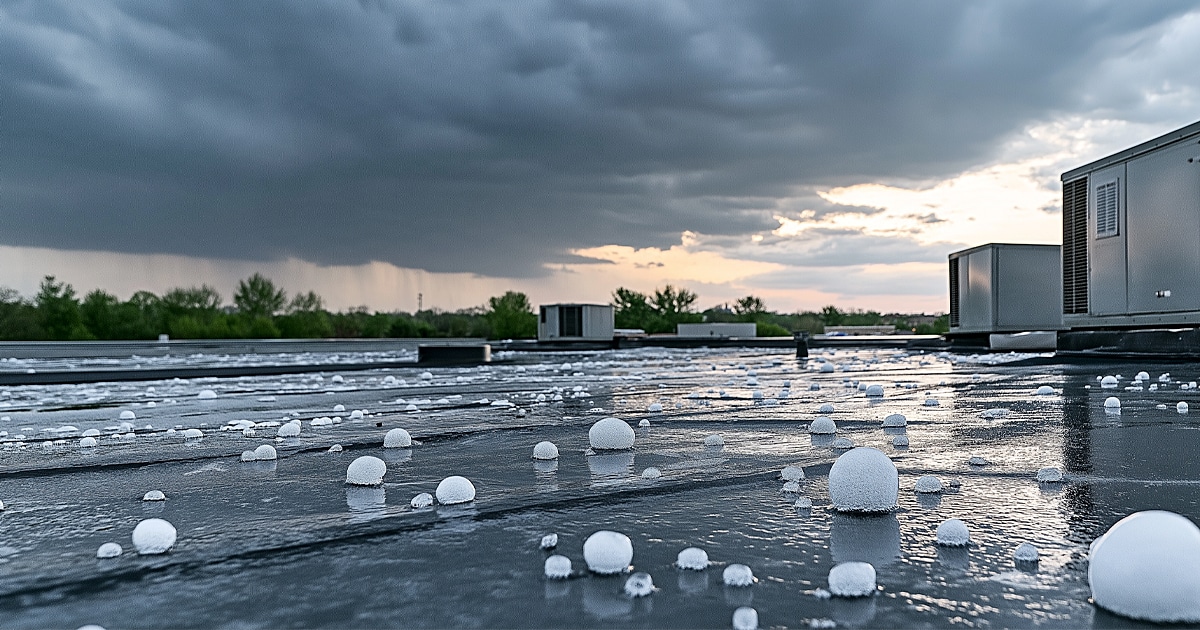
Hail hits Texas commercial roofs hard, and some of the most important hail damage is not immediately visible from the parking lot or even during a quick walk across the roof. Building owners who understand how hail damage affects different roofing systems are in a better position to document conditions, address urgent problems, and make informed decisions about roof repairs, maintenance, insurance claims, and possible roof replacement.
A commercial roof is more than the exposed surface you can see. Membranes, cover boards, insulation, flashing, seams, fasteners, drainage components, rooftop equipment, and the roof deck all work together, which means a storm can affect one part of the assembly without creating an immediate leak somewhere else. That is especially important on flat roofs and other low-slope commercial roofs, where storm damage beneath the roof surface can remain hidden until heavy rain, foot traffic, thermal movement, or another major storm exposes a weak point.
Key Takeaways
- Hail damage on commercial roofs can affect membranes, cover boards, insulation, seams, flashing, drainage components, metal panels, shingles, and rooftop equipment. A roof can sustain functional roof damage without leaking right away.
- Different roofing materials respond differently to hail impact. TPO, PVC, modified bitumen, built-up roofing, coatings, metal roofing, and asphalt shingles each have their own warning signs and inspection needs.
- Commercial property owners should document visible damage after a hail storm and arrange a roof inspection when the property has been exposed to significant hail, high winds, or other storm damage.
- Insurance coverage varies by policy. Actual cash value, replacement cost provisions, deductibles, cosmetic-damage exclusions, notice requirements, and other terms can all affect an insurance claim.
- Ja-Mar Roofing & Sheet Metal provides commercial roofing services across multiple Texas markets and can inspect commercial properties for hail damage, leaks, and other storm-related roof damage.
How Hail Damages Commercial Roofs (Direct Answer Overview)
Hail damage to commercial roofs can include punctures, bruised membranes, crushed cover boards and insulation, split or stressed seams, damaged flashing, displaced surface granules, clogged drains, dented metal panels, and impact damage to HVAC units or other rooftop equipment. Some roof hail damage is easy to see, but other damage is not immediately visible and may remain below the roof surface until the roofing system is stressed again.
Hail impact severity depends on hail size, wind speed and direction, roof age, material type, substrate, installation method, and the condition of the entire roof before the storm. TPO, PVC, modified bitumen, built-up roofing, coatings, metal roofing, and asphalt shingles respond differently, so a roof inspection should be based on the roofing materials actually installed rather than on a generic hail checklist.
Hail around 2.5 cm, or roughly 1 inch, can damage some roofing materials, but that is not a universal damage threshold. The National Weather Service uses 1-inch hail as a severe-thunderstorm criterion, while the actual roof damage at a commercial property depends on the roof system, hail characteristics, high winds, and existing condition.
Smaller hail can still matter on older or vulnerable materials, and smaller hail may be more consequential when high winds increase the angle of impact. A commercial roof does not have to leak immediately to have sustained hail damage, and storm damage can remain concealed until the system is stressed again. Small fractures, weakened seams, soft spots, damaged flashing, or compromised insulation can remain dry through one rainfall and then become a source of moisture entry during later rainfall or another storm.
Key Factors That Influence Commercial Hail Damage
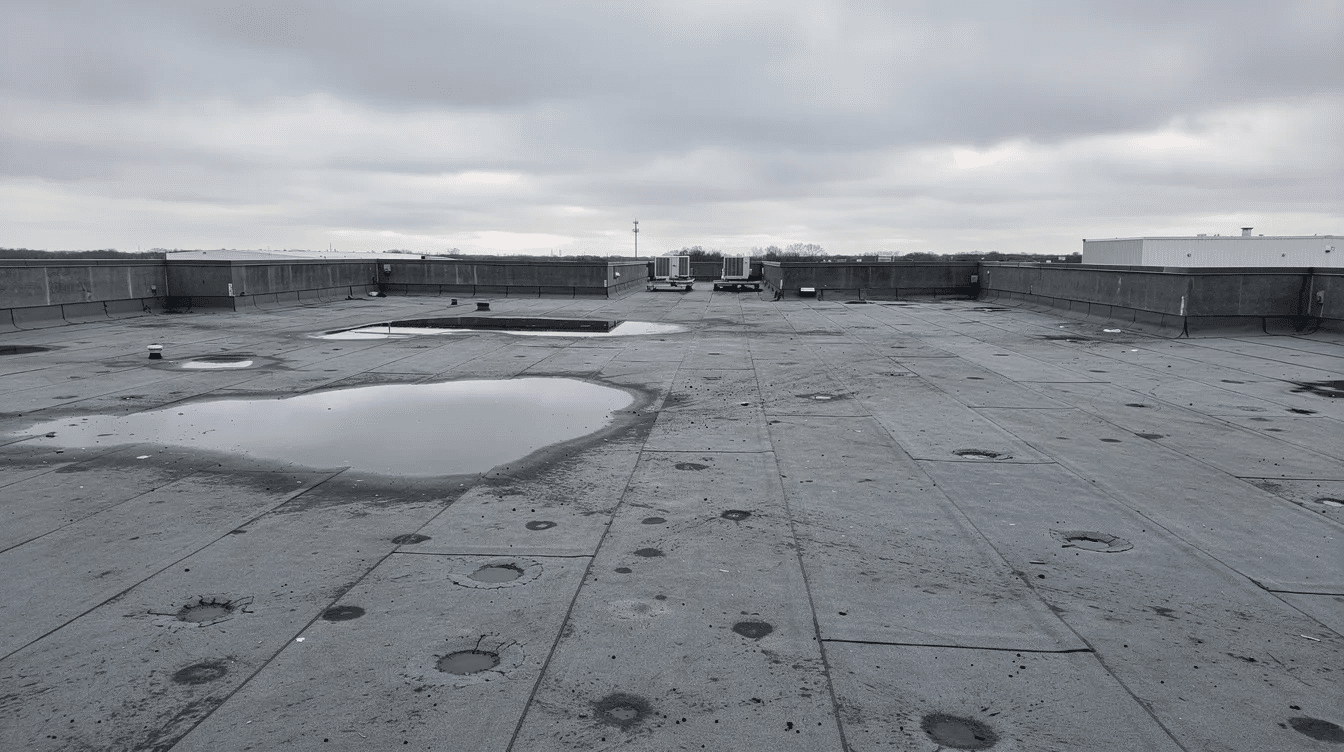
The same hail storm can affect neighboring commercial buildings in very different ways, and the resulting storm damage may not follow the property line or look the same from one roof to the next. One property may have a newer membrane over a dense cover board, while another has an older roofing system with previous repairs, softer insulation, or years of exposure to Texas heat. Those differences change how the roof absorbs a hail hit and how much damage is visible afterward.
Hail-related variables include stone diameter, shape, density, storm duration, wind direction, and local wind conditions. Hail can cause damage when stones reach approximately 2.5 to 4.4 cm, or about 1 to 1.75 inches, but there is no single size that guarantees roof damage on every building. High winds can also drive hail at an angle into parapets, wall flashing, gutters, HVAC units, skylights, and vertical surfaces that may receive less impact when hail falls more vertically.
Severe thunderstorms in Austin and Central Texas can produce damaging winds, large hail, and heavy rain. That local storm pattern matters for commercial property owners because repeated storm damage over multiple seasons can affect older roofing systems differently than a single isolated event.
Commercial roofs in Central Texas commonly include low-slope or flat roofs, and many larger properties have multiple flat roofs connected by walls, parapets, or changes in elevation. Drainage becomes especially important after a major storm because debris can collect around drains and scuppers, while hail impact or displaced roofing materials can create depressions that hold water. Roof age, existing wear, previous roof repairs, foot traffic, and the materials below the roof surface can all influence whether minor problems remain stable or become costly repairs later.
Rooftop equipment also changes the way a commercial roof experiences hail. HVAC units, pipe supports, cable trays, mechanical screens, skylights, vents, and curbs create additional edges, seams, flashings, and impact-sensitive areas. Many commercial buildings have several roof sections installed at different times, so the entire roof should not be treated as though every area has the same age, material, or exposure.
How Fast Does Hail Fall, and Can Hailstones Reach 100 mph?
You may see the statement that hailstones can fall at speeds over 100 mph, or that hailstones can reach speeds over 100 mph upon impact. Older calculations based on idealized solid ice spheres produced very high estimates, but NOAA’s National Severe Storms Laboratory explains that natural hailstones generally fall more slowly because real hail varies in shape, surface texture, melting, and wind exposure.
NOAA estimates expected fall speeds of roughly 9 to 25 mph for hail smaller than 1 inch and about 25 to 40 mph for hail between 1 and 1.75 inches. Larger hail can fall faster, and strong horizontal winds can significantly change the direction and effective impact on a commercial building, which is why wind-driven hail can still produce serious property damage without relying on a blanket 100-mph figure.
For a property owner, the practical issue is how the roofing system responded to the hail impact. A weather report can help confirm that a storm crossed the area, but the condition of the commercial roof, rooftop equipment, gutters, windows, and other exposed surfaces provides the better picture of what happened at the specific property.
What Hail Can Do to Different Commercial Roof Systems
Commercial roofs respond differently to hail depending on material, age, installation, and the roof assembly below the exposed surface. Inspectors need to understand those differences because visible damage on metal roofing may look nothing like the signs of hail on a TPO membrane, modified bitumen cap sheet, coating, or shingle surface.
Single-Ply Membranes: TPO and PVC
TPO and PVC are common on warehouses, retail centers, office buildings, industrial facilities, healthcare buildings, schools, and many other commercial properties. These single-ply roofing systems rely on a membrane and heat-welded seams to create a watertight surface, and the assembly beneath the membrane often plays a major role in hail performance.
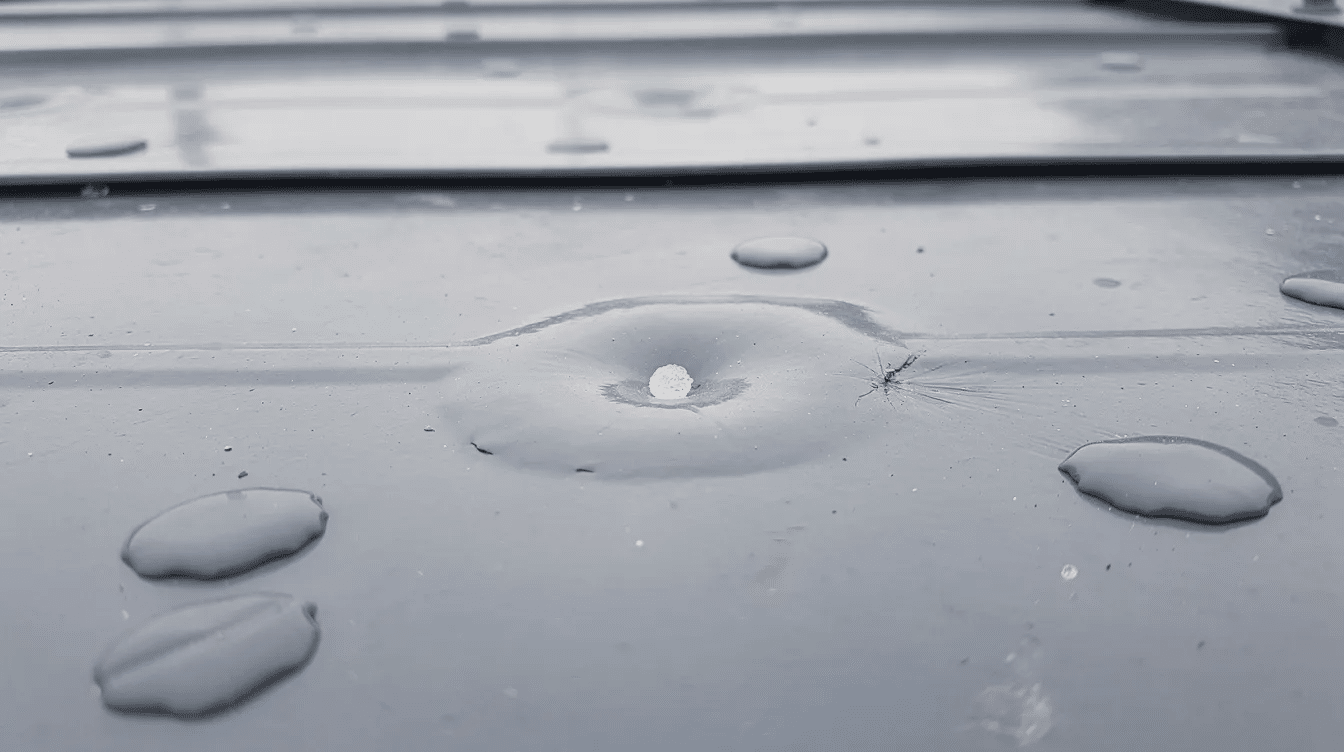
Hail can cause circular or star-shaped fractures in single-ply roofing membranes, along with punctures, bruising, depressions, or localized damage over hard points. A hail hit over a fastener plate, substrate joint, or other rigid location can create a different stress pattern than an impact in the middle of a well-supported membrane area.
Hail can also compress or damage insulation boards and cover boards beneath roofing membranes. The exposed membrane may flex under impact while the material below it absorbs more of the force, leaving soft spots or subtle depressions even when an obvious puncture is not immediately visible.
Heat-welded seams and flashing deserve careful attention as well. Hail impact does not automatically mean a seam has failed, but impact, roof age, existing stress, and wind-driven movement can combine to create conditions that deserve closer review. Punctures and tears from large hail can expose insulation directly to water, while smaller fractures can become more important after later thermal movement or foot traffic.
Where the roof condition justifies it, a professional inspection may include moisture testing, infrared evaluation under appropriate conditions, or limited core cuts to check roof layers and suspected moisture. Destructive testing should be used selectively and with attention to manufacturer requirements when the roof is under warranty.
Modified Bitumen and Built-Up Roofing (BUR)
Modified bitumen and built-up roofing are common on older commercial properties and on buildings that have been repaired or reroofed in stages. These asphalt-based roofing systems can be durable, but hail damage often looks different from the impact marks found on metal or white single-ply membranes.
Modified bitumen roofs can experience granule loss, internal bruising, surface fractures, damaged laps, or cracking around rigid transitions. Dark patches on a granulated cap sheet can indicate missing protective granules, but normal aging and foot traffic also cause granule loss, so the pattern needs to be evaluated in context.
Inspect gutters, drains, and low areas for fresh granule accumulation after a hailstorm. Protective granules can move toward drainage paths during rainfall, although granules by themselves do not prove that the roof suffered recent hail damage. Fresh impact patterns, collateral damage, pre-storm photographs, and the overall condition of the roofing material help an inspector tell storm damage from normal wear. Good documentation helps building owners understand what is new, what was already present, and what needs to be addressed regardless of an insurance claim.
On built-up roofing with gravel surfacing, hail can displace aggregate, drive gravel into underlying plies, split blisters or ridges, and move loose material into drains. Damage can be difficult to see below embedded aggregate, so representative areas may need closer inspection when there are leaks, obvious impact patterns, or other warning signs.
Some properties also combine modified bitumen or BUR with asphalt shingles on steep-slope sections. Large hail can crack or break shingles, bruise the shingle surface, and knock away protective granules, which is why every roofing material on the property should be included in the inspection.
Commercial Roof Coatings
Many Texas commercial roofs are protected by silicone, acrylic, elastomeric, or other roof coatings applied over existing membranes or metal roofing. Hail can chip, crater, crack, or thin those coatings, particularly over fasteners, seams, panel ribs, substrate irregularities, and previous repair areas.
Hail-damaged coatings may show small impact craters, hairline cracks, adhesion loss, or exposed substrate. The coating can still look generally intact from several feet away, which makes close inspection important when the building experienced a significant storm.
Loss of coating thickness can shorten the restoration system’s useful life by exposing the surface below to ultraviolet light, water, and normal thermal movement. At the same time, inspectors need to separate fresh storm damage from dirt, foot traffic, old repairs, weathering, and other conditions that can mark a coating over time.
Metal Roofing Systems
Standing seam and exposed-fastener metal roofing systems are common on industrial buildings, self-storage facilities, retail centers, warehouses, churches, and other commercial buildings. Heavy hail can dent metal roofing panels without puncturing them, so the presence of dents does not automatically tell a property owner whether the damage is cosmetic, functional, or a combination of both.
Dents on metal roofs help show where hailstones struck, while examining softer metals such as aluminum gutters, downspouts, vents, and flashing can help establish the overall impact pattern. A direct hail hit can also damage factory-applied coatings, distort seams, affect fasteners or clips, and compromise sealant around penetrations or end laps.
Exposed-fastener systems deserve close inspection around screw locations and washers, while standing seam systems need evaluation at seams, clips, transitions, ridges, eaves, and penetrations. If hail damages the protective finish and exposes bare metal, the long-term concern can include corrosion even when the roof remains watertight immediately after the storm.
During inspection, document the size, density, and direction of dents with both wide shots and close ups. That documentation can help distinguish recent hail damage from foot traffic, dropped tools, previous maintenance, or older storm damage.
Asphalt Shingles on Commercial Buildings
Unlike many homeowners who are dealing with one primary roof system, commercial property owners may be responsible for buildings that combine several materials. Many commercial buildings use asphalt shingles on offices, restaurants, churches, medical buildings, apartment communities, retail properties, and other steep-slope sections. A single property may have shingles on one roof area and TPO, modified bitumen, or metal roofing on another.
Hail can bruise asphalt shingles, displace protective granules, expose asphalt, crack edges, or break shingles when impact is severe enough. Quarter-sized hail can damage shingles under the right combination of material age, roof condition, wind, and impact angle, but it should not be treated as a guarantee that every shingle roof suffered functional damage.
Dark patches on the shingle surface can indicate areas where protective granules have been displaced. Granule loss also occurs naturally as shingles age, so the inspector should compare impact patterns with dents in gutters, flashing, vents, and other collateral surfaces rather than diagnosing hail damage from granules alone.
Some online sources claim hail can take 5-10 years off a 30-year shingle’s lifespan. There is no reliable rule that assigns a fixed number of years to every hail event, because the effect on shingles depends on the storm, the condition of the roof, the age of the material, and whether the hail actually caused functional damage. A professional roof inspection is more useful than applying a generic lifespan reduction to every hail damaged roof.
Visible vs. Hidden Hail Damage on a Commercial Roof
What property owners can see from the ground often provides the first clue that a building took a direct hit. Dented metal gutters, damaged downspouts, broken windows, cracked skylights, bent HVAC fins, damaged signs, or impact marks on wall panels can all point to a storm that deserves a closer look.
Damage visible on the roof may include dents in metal panels, punctures, cracked coatings, displaced gravel, damaged flashing, obvious membrane fractures, or freshly displaced granules. These are useful warning signs, but they do not reveal every problem within the roofing system or every form of storm damage below the surface.
Hidden hail damage is often more difficult to evaluate because the issue may sit below the exposed roof surface. Crushed insulation, damaged cover board, stressed seams, micro-fractures, or small openings around flashing can remain dry for a period of time and then allow water intrusion during later rainfall.
Soft spots can indicate wet or compressed material below the roof, but they can also result from older moisture, previous repairs, deteriorated substrate, or other conditions unrelated to the latest storm. An inspector should investigate the cause rather than assuming every soft area proves recent hail damage.
Look for signs of water damage inside the building as well. Water stains on ceiling tiles, damp insulation, moisture near roof drains, discoloration around penetrations, humid air in enclosed spaces, or water damage inside mechanical rooms can help identify areas that deserve closer evaluation. Even small leaks should be traced to the source instead of being treated only as an interior cleanup issue. Mold growth usually indicates moisture has been present long enough to create favorable conditions, so mold should not automatically be blamed on a storm that happened only a day or two earlier.
Many commercial buildings show no obvious damage from the parking lot even when the roofing system has been affected. That is why the absence of visible damage from the ground should not be treated as proof that the entire roof escaped the storm.
Critical Areas to Check on a Hail-Damaged Commercial Roof
A structured roof inspection helps keep important areas from being overlooked after a major storm and creates a consistent record of storm damage across the property. The field of the roof matters, but seams, penetrations, drainage, rooftop equipment, and interior conditions can provide equally important information.
- Membrane and field of roof: Inspect the roof surface for punctures, fractures, impact marks, soft spots, depressions, coating damage, granule loss, or changes in surface texture.
- Seams, laps, and flashing: Inspect perimeter edges, parapet walls, curb flashing, pitch pans, penetrations, and other transitions for splits, movement, lifted areas, or failed sealant.
- Drainage components: Check internal drains, scuppers, strainers, leader heads, metal gutters, and downspouts for dents, debris, displaced granules, or damage that could interfere with drainage and contribute to ponding water.
- Rooftop equipment: Inspect AC units, additional AC units, HVAC units, vents, skylights, walk pads, pipe supports, solar components, cable trays, and equipment curbs for impact damage and compromised seals.
- Steep-slope sections: Where commercial buildings include shingles, inspect the shingle surface for bruising, cracked or broken shingles, granule loss, and damage around vents and flashing.
- Interior documentation: Note water stains, wet ceiling tiles, damp areas, and other signs of water damage inside the building.
Document all visible storm damage with photos and videos. Use wide shots to establish location and overall patterns, then take close ups of individual impact points, seam problems, flashing damage, equipment damage, and other areas that may support later repair planning or an insurance claim.
Why Post-Storm Commercial Roof Inspections Matter
Commercial hail damage can be progressive when a damaged area is left exposed to heat, foot traffic, heavy rain, and additional storms. A roof inspection after severe weather helps property owners identify current roof damage and storm damage while there is still time to address minor problems before they spread into larger roof repairs or interior water damage. Some minor problems can be fixed quickly when they are found before water reaches deeper parts of the assembly.
Prompt documentation can also help with insurance claim requirements. Insurance companies generally expect policyholders to provide timely notice of a loss, but the actual deadlines and conditions depend on the insurance policy. Texas commercial property owners should review their policy instead of relying on a universal statement that every hail claim follows the same filing deadline.
A professional roof inspection may reveal damage that is not visible from the ground. Depending on the roofing system and what the inspector finds, further evaluation can include moisture meters, infrared imaging under suitable conditions, or limited core cuts to check for trapped moisture, damaged insulation, or other hidden conditions.
Inspection findings also help with repair-versus-replacement decisions. If damage is limited, targeted roof repairs may preserve an otherwise serviceable system. If hail impact is widespread and the roof already has extensive wear, moisture, repeated repairs, or limited remaining service life, a larger restoration or roof replacement may deserve consideration.
For property owners who want ongoing documentation beyond the immediate storm response, Ja-Mar’s commercial roofing programs provide scheduled inspection, maintenance, repair documentation, and service options for commercial properties. These records can also make it easier to compare future storm damage against the roof’s documented condition before a new roof or major repair is needed.
Do Hail Damage Claims Have to Be Filed Within One Year?
The statement that hail damage claims must be filed within one year is not a universal rule for every Texas commercial property insurance policy. Commercial property owners should report suspected damage promptly and review the specific notice and filing provisions in their insurance policy, because requirements can vary by carrier, policy form, endorsement, and type of coverage.
Some specialized programs can have their own deadlines, and an owner who plans to file a claim should confirm those requirements early. This is one reason generic online advice can be misleading. The safer approach is to document the storm damage, contact the insurance company or insurance provider when a potentially covered loss is discovered, and confirm the applicable requirements under the actual policy.
Working with Your Insurance Company on Commercial Hail Damage
Hail damage claims on commercial roofs often involve coordination among the property owner, roofing contractor, insurance company, and adjuster. Documentation drives much of that process, which is why dated photographs, roof plans, maintenance records, previous inspection reports, weather information, emergency repair invoices, and written findings can all be useful. A well-documented insurance claim gives the insurance company a clearer record of the storm damage being reported and can reduce confusion about what was present before the event.
Document all visible storm damage for your insurance claim before permanent repairs change the condition whenever it is safe to do so. If you file a claim, keep copies of the inspection report, photographs, estimates, invoices, and correspondence connected with the insurance claim. If emergency roof repairs are needed to prevent further damage, photograph the condition before and after the work and keep invoices or other records showing what was done.
Replacement Cost and Actual Cash Value provisions can affect how an insurance claim is valued, and the insurance claim should be reviewed against the actual policy rather than a generic online example. That keeps the insurance claim tied to the documented loss and the policy that actually governs the property. Neither term guarantees a particular payment. Actual cash value generally accounts for depreciation, while replacement cost coverage may provide additional payment for covered replacement work after policy requirements are met. Deductibles, limits, exclusions, depreciation methods, endorsements, and the scope of covered damage can all affect the final claim outcome.
Some commercial insurance policies include cosmetic-damage language that may be relevant to metal roofing. Dents that change appearance but do not affect water-tightness can be treated differently from functional damage involving seams, fasteners, flashing, coatings, panel geometry, or punctures. Property owners should confirm how their insurance coverage applies with the insurance company rather than relying on assumptions.
A roofing contractor can document roof damage, prepare roof repairs or roof replacement scopes, explain roofing materials and installation requirements, and meet with the adjuster to discuss observed conditions. The roofing contractor has an important but limited role, and the roofing contractor’s documentation should stay focused on the physical condition of the roof. A qualified roofing contractor can also help identify storm damage that needs to be fixed quickly to prevent additional moisture from reaching the building. The contractor should not make coverage decisions or promise what the insurance provider will pay.
Does Tennessee’s Matching Law Apply to a Texas Commercial Roof?
You may see the statement that “Tennessee’s matching law requires insurers to match undamaged roof sections” in national roofing and insurance content. Whatever matching requirements may apply in Tennessee or Middle Tennessee, they do not control a Texas commercial roof claim, and property owners should not assume an out-of-state rule applies to a building in Austin, San Antonio, Central Texas, or another Texas market.
Matching, material availability, repairability, policy language, and state insurance requirements can vary. For a Texas commercial property, the insurance company applies the policy and applicable Texas requirements, while the roofing contractor documents whether materials can be repaired, replaced, or integrated properly with the existing roofing system.
Repair vs. Replacement: Deciding What a Hail-Damaged Roof Really Needs
A hail damaged roof does not automatically require replacement. When damage is isolated to a few punctures, limited flashing problems, localized coating loss, or another contained area, roof repairs can make sense if the surrounding roofing system remains in good condition and the repair can be completed with compatible materials.
The calculation changes when commercial roof damage or other storm damage is widespread, insulation or cover board is affected across several areas, water intrusion has moved beyond the original impact points, or an older roof has already accumulated years of repair work. In those situations, continuing to patch minor problems one at a time can become more expensive than developing a larger plan for the entire roof.
Roof age matters, but age alone should not decide the outcome. An older commercial roof that has been maintained well may still have useful service life, while a newer roof can develop serious problems after installation defects, repeated storm damage, or long-standing leaks. Property owners should look at the condition of the roofing materials, moisture, repair history, warranty requirements, business disruption, and the expected performance of the proposed work.
If a roof replacement is being considered, the owner should also ask whether the new roof can be designed with a more impact-resistant assembly. Membrane thickness, cover board, insulation, attachment method, metal gauge, coating system, and other details can influence how a new roof performs during future hail season events.
For Austin and Central Texas properties, Ja-Mar provides commercial roofing services for repair, maintenance, replacement, and new construction, including low-slope and metal roofing systems commonly found on commercial buildings.
What Hail Can Do to Roof Insulation and Cover Boards
The materials below the visible roof surface are easy to overlook because property owners rarely see them until a roof is opened. On many low-slope commercial roofs, insulation and cover board provide support beneath the membrane while also contributing to thermal performance, impact resistance, and long-term durability.
Hail impact can compress softer insulation, fracture certain cover boards, or create localized depressions that change how the membrane is supported. This can contribute to soft spots, ponding water, or additional stress from foot traffic even when the exposed membrane is not obviously punctured.
A dense cover board can improve hail resistance, which is why some commercial roofing systems are specifically designed and tested for severe or very severe hail exposure. The performance comes from the complete assembly rather than from the membrane alone.
Soft spots should still be evaluated carefully because storm damage is only one possible cause. Previous leaks, wet insulation, deteriorated decking, poor adhesion, older repairs, or mechanical damage can produce similar conditions. A professional inspection helps determine whether the area is related to the latest storm or another roof problem that still needs attention.
What to Expect from a Professional Commercial Roof Hail Inspection
Knowing what a professional inspection should include makes it easier for property owners and facility managers to coordinate access, safety, and documentation. The process usually begins with the building’s roof history and the storm damage reported at the property, including approximate age, previous leaks, repair records, warranty status, known problem areas, and details about the storm.
On the roof, the inspector should work systematically rather than heading only toward the most obvious dents. The field of the roof, seams, flashing, perimeter, penetrations, drains, scuppers, metal gutters, rooftop equipment, previous repair areas, and any steep-slope shingle sections all deserve attention.
Different roofing materials require different evaluation methods. A metal roofing system may need close review of seams, fasteners, clips, coating damage, and panel geometry, while TPO or PVC may require attention to punctures, fractures, hard points, seams, and the condition of the substrate below. Modified bitumen and shingles call for a closer look at protective granules, bruising, cracking, and surface wear.
A useful written report should include a roof plan or clear location references, wide shots showing overall patterns, close ups showing specific conditions, and recommendations that separate observation from repair scope. If additional testing is recommended, the report should explain why it may be useful rather than treating every roof as though it automatically needs core cuts or infrared imaging.
In Texas, experienced commercial contractors such as Ja-Mar Roofing & Sheet Metal inspect a wide range of roofing systems and can help property owners understand whether the roof needs maintenance, targeted roof repairs, more extensive restoration, or roof replacement. The roofing contractor should be familiar with the specific commercial systems installed on the building, and property owners can review Ja-Mar’s Texas roofing service areas to find the nearest market.
Commercial Roof Warranties and Hail Damage
Commercial roof warranties and manufacturer guarantees vary, so it is risky to make a blanket statement that all warranties cover hail or that none of them do. Some standard commercial warranty programs exclude hail or other storm impact unless additional hail coverage was purchased for an eligible roofing system, while other products or guarantee options may provide specific hail-related protection.
The actual warranty documents should be reviewed before permanent work begins. Manufacturer requirements may address notice, inspection, approved contractors, repair methods, or the materials that can be used without affecting the remaining warranty.
This is also another reason routine documentation matters. A property owner who can provide prior inspection reports, maintenance records, warranty information, and previous repair history gives the manufacturer and roofing contractor a clearer picture of the roof before and after the storm. An experienced roofing contractor can also help identify the repair method required by the existing system.
What Property Owners Can Safely Check from the Ground
Commercial property owners do not need to climb onto a wet or damaged roof to begin documenting a storm. Exterior evidence can provide useful information while avoiding the hazards associated with standing water, slippery membranes, damaged skylights, loose metal, electrical equipment, and unfamiliar roof access.
Walk the property and look for dents in metal gutters, downspouts, signs, exterior HVAC equipment, wall panels, vents, and other soft metals. Photograph broken windows, damaged screens, cracked skylights that can be viewed safely, damaged vehicles, and other property damage that may show the direction or intensity of the hail.
Inside the building, look for water stains, wet ceiling tiles, active leaks, damp areas, and water damage inside storage rooms, offices, tenant spaces, or mechanical areas. Ask employees or tenants whether they noticed leaks during the storm, since some leaking can stop once the heavy rain ends.
Use both wide shots and close ups when documenting damage. Wide shots show where the condition is located, while close ups capture the specific detail. Record the date and approximate time of the storm while the information is still easy to verify.
FAQ: Commercial Roof Hail Damage
These questions address practical concerns commercial property owners, facility managers, business owners, and other property decision-makers often raise after a Texas hail season event.
How big does hail have to be to damage a commercial roof?
There is no single size that guarantees commercial roof damage, but hail around 2.5 cm, or about 1 inch, is large enough to deserve attention after a significant storm. The actual outcome depends on roofing materials, age, wind, substrate, impact angle, previous repairs, and existing condition. Smaller hail can damage vulnerable surfaces, while a stronger roof assembly may perform better under larger stones. Smaller hail should still be evaluated in the context of roof age and material condition.
Can hail cause damage when stones reach 2.5 to 4.4 cm?
Yes. Hail in the 2.5 to 4.4 cm range, about 1 to 1.75 inches, can damage membranes, shingles, coatings, metal roofing, skylights, HVAC equipment, gutters, flashing, and other exposed components. The same storm can still produce different results on neighboring buildings because roof construction and condition vary.
Can hailstones fall at speeds over 100 mph or reach speeds over 100 mph upon impact?
The statements “hailstones can fall at speeds over 100 mph” and “hailstones can reach speeds over 100 mph upon impact” come from older simplified calculations and should not be treated as a description of normal severe-thunderstorm hail. NOAA reports much lower expected fall speeds for common hail sizes, while noting that actual speed varies with size, shape, wind conditions, and melting. Very large stones can fall faster, and high winds can drive them into a building at damaging angles.
Can hail take 5-10 years off a 30-year shingle’s lifespan?
You may see the claim that hail can take 5-10 years off a 30-year shingle’s lifespan, but there is no reliable fixed formula that applies to every roof. Storm impact can shorten the service life of shingles by causing bruising, cracking, granule loss, or other functional damage, but the effect depends on roof age, material condition, storm severity, and the damage actually present.
My commercial roof is not leaking after the storm. Should I still get it inspected?
A roof does not need to be leaking to have sustained damage, and leaks may not appear until later weather stresses the affected area. Membrane fractures, damaged flashing, stressed seams, crushed insulation, or other conditions may not produce water intrusion until later heavy rain or thermal movement. A roof inspection can determine whether the commercial roof needs attention before minor problems grow into costly repairs.
What are the first signs of hail damage?
The first signs are often found on impact-sensitive surfaces such as gutters, downspouts, HVAC units, vents, skylights, signs, and exposed flashing. On the roof, visible damage can include punctures, dents, fractures, coating damage, granule loss, broken shingles, or bruised roofing materials. Interior water stains and leaks can also point to areas that need further inspection.
Can hail damage void my commercial roof warranty?
Warranty terms vary. Some commercial warranties or guarantees exclude hail unless additional hail coverage was purchased, while other systems may have specific hail-related options or requirements. Review the actual warranty and contact the manufacturer or warranty administrator before permanent roof repairs if the roof is still covered.
Do hail damage claims have to be filed within one year?
The statement that hail damage claims must be filed within one year does not apply universally to every Texas commercial insurance policy. Property owners should report suspected damage promptly and check the insurance policy for notice and filing requirements. The insurance company, agent, or broker can clarify the deadline that applies to the specific policy.
Does Tennessee’s matching law apply to Texas commercial property?
No. Tennessee’s matching law may appear in national roofing and insurance content, but it does not govern a Texas commercial property claim. Texas property owners should rely on their policy and applicable Texas rules rather than assuming a Tennessee or Middle Tennessee requirement applies to their building.
How often should I have my commercial roof inspected in hail-prone areas like Texas?
Inspection frequency depends on roof age, system type, warranty requirements, maintenance history, building use, and exposure. Many property owners use routine inspections during the year and add a professional inspection after significant storm damage or a known hail event. Consistent documentation makes it easier to identify changes after the next storm season.
Does a free inspection obligate me to use that contractor for repairs?
A reputable contractor offering a free inspection should explain what was found and what, if anything, needs attention without requiring the property owner to approve repairs on the spot. Before authorizing work, verify insurance, commercial roofing experience, references, and familiarity with the roofing systems on the building.
Know the Roof’s Condition Before Small Problems Become Bigger Ones
Commercial roof hail damage is not always dramatic, and the most visible condition is not necessarily the most important one. A dented metal panel may remain functional, while a small membrane fracture or damaged seam can eventually allow water intrusion that affects insulation and interior spaces.
For commercial property owners, the practical response after a severe storm is to document what happened, address active leaks and safety concerns, arrange a professional roof inspection when the property shows signs of hail or other storm damage, and make repair or replacement decisions based on the actual condition of the roof.
Ja-Mar Roofing & Sheet Metal provides commercial roofing services for businesses, business owners, building owners, property managers, industrial facilities, and other commercial properties across Texas. If a recent storm may have affected your building, contact Ja-Mar Roofing & Sheet Metal to request a free inspection and get a clearer picture of what, if anything, the roof needs.

