
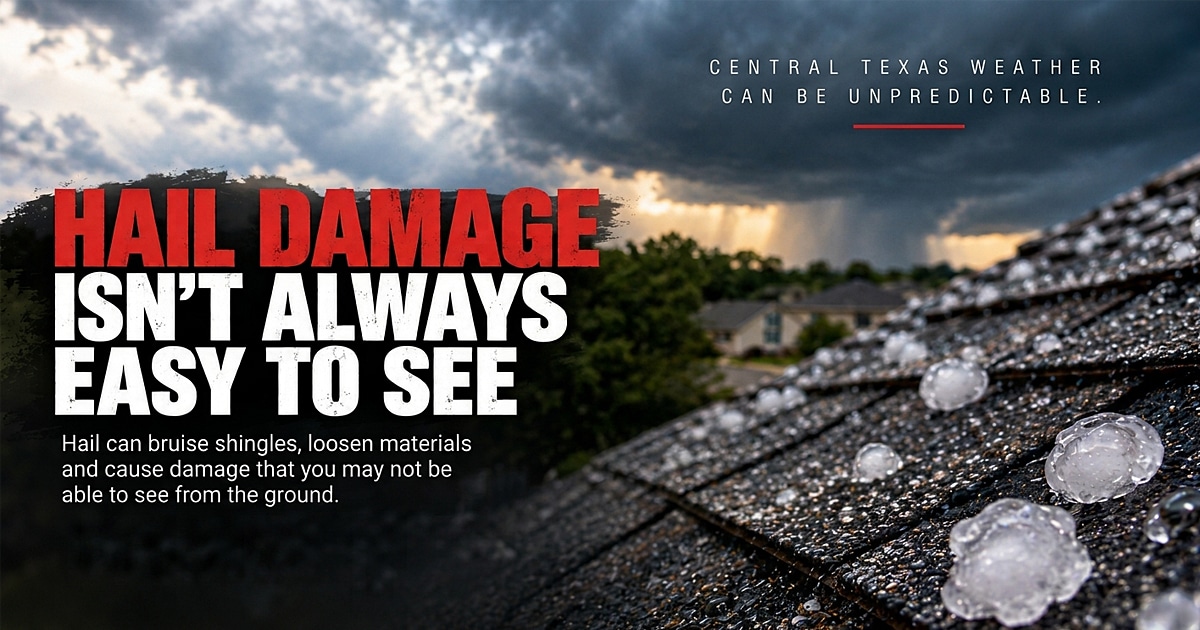
After the severe weather that moved through Bexar County on September 11, 2026, a lot of residents woke up asking the same question after a San Antonio hailstorm: can roof damage be seen from the ground? Sometimes, yes. Missing shingles, dented gutter runs, damaged exterior cladding, fallen branches, and other obvious problems may be noticeable from the yard. But many hail-related problems are much harder to recognize from below, especially on asphalt shingles, vents, flashing, and other components that need to be viewed up close.
That matters after a storm like the one that hit the eastern side of the San Antonio area Friday night. Reports included hail near Converse, Kirby, Saint Hedwig, and China Grove, with some hailstones reported from quarter size up to golf-ball size in the Paloma area. A roof can look normal from the driveway and still deserve a closer look, particularly when nearby cars, drainage components, fences, screens, or exterior AC equipment show fresh impact marks.
The goal is not to assume every home in the storm path was damaged. Hail can vary dramatically from one neighborhood to the next, and even from one side of a street to the other. The better approach is to check the property safely, document anything unusual, and schedule a professional roof inspection when the storm produced severe hail or obvious exterior damage nearby.
Key Takeaways
- Some hail damage, such as missing shingles, dented gutters, damaged exterior cladding, and debris in the yard, can be spotted without climbing onto the home.
- Most subtle impact damage to composition shingles is difficult to evaluate accurately from a driveway or sidewalk.
- Fresh dents on cars, gutter runs, downspouts, garage doors, fencing, and outdoor AC units can help show that a home took hard impacts.
- Bruised shingles, fractured shingle mats, damaged flashing, and compromised vents usually require a close-up professional inspection.
- A September 11, 2026 hail storm affected parts of eastern Bexar County, including areas around Converse, Kirby, Saint Hedwig, and China Grove.
- Insurance coverage and claim deadlines vary by policy, so homeowners should document storm damage promptly and review their own policy instead of assuming a universal filing deadline.
- If the roof appears fine but surrounding property shows fresh impact marks, a free inspection can help determine whether a repair is needed or whether no action is necessary.
Understanding San Antonio Hailstorms and Roof Damage
San Antonio homeowners are used to severe weather in the spring, but hail is not limited to March, April, May, or June. Strong thunderstorms can produce damaging hail outside the traditional spring season when atmospheric conditions come together. Warm, moist air near the surface, instability higher in the atmosphere, and strong updrafts can all help keep hailstones suspended long enough to grow before they fall.
The September 11, 2026 hailstorm is a good example. It also shows why a late-summer or early-fall hail storm should not be dismissed simply because the traditional spring season has passed. Severe weather developed over portions of central and eastern San Antonio late Friday evening. Local reports included hail around Converse, Kirby, Saint Hedwig, and China Grove, with some stones reaching approximately 1.5 inches and reports of golf-ball-size hail in the Paloma subdivision. The storm also produced strong winds, lightning, power outages, and scattered exterior damage.
That kind of hailstorm can wreak havoc in a very uneven pattern. One subdivision may receive large hail for several minutes while a neighborhood a few miles away gets heavy rain and wind with little or no hail. Even within the same neighborhood, tree cover, wind direction, the pitch of the home, age of the roof covering, and which slopes faced the storm can change what happened.
This is why a neighborhood-wide assumption is risky. A neighbor may have significant damage while your home does not. The opposite can happen too. One house may have older shingles that bruise more easily, while the next home has newer Class 4 shingles that perform better under the same impacts.
San Antonio has a long history of severe hail. A 6.4-inch hailstone set a Texas state record in Hondo in 2021, west of San Antonio, while the San Antonio metro has also experienced extremely large hail during past events. The lesson is not that every storm produces record stones. It is that South-Central Texas has the atmospheric setup for serious hail, and residents should take fresh impact evidence seriously.
What happened during the September 11, 2026 San Antonio hail storm?
The most useful local detail for homeowners is where confirmed hail was reported. Friday night’s storm affected the eastern side of the metro. Reports included 1-inch hail near Saint Hedwig and China Grove, 1 to 1.5-inch hail near Kirby, and dime-to-golf-ball-size hail near Converse in the Paloma subdivision. Some reports also included wind gusts capable of damaging roofs, exterior walls, trees, and other exterior components.
Those reports do not prove that every property in those communities needs hail damage repair. They do tell residents in the affected corridor that it is reasonable to check their property. If you live in or near Converse, Kirby, Windcrest, Saint Hedwig, China Grove, or the east side of San Antonio and saw hail at your home, heard repeated impacts, or found fresh exterior damage the next morning, the storm was strong enough to justify a closer look.
It is also worth remembering that hail size is only one part of the equation. A one-inch stone driven by strong winds can hit roofing materials at a much different angle and force than hail falling nearly straight down. Older shingles, already weathered by years of San Antonio heat and UV exposure, can also be more vulnerable than newer materials.
Why the roof can look fine after a damaging storm
People naturally look for dramatic signs: a hole, missing shingles, a tree on the home, or water pouring from a ceiling. Those are obvious problems, but they are not the only kinds of storm damage that matter.
Hail often affects the outer layers of a shingle first. It can knock away protective granules, compress the asphalt layer, create a bruise, or weaken the internal reinforcement. From below, the shingle field can still look straight and intact. There may be no missing pieces, no hole, and no immediate leak.
The same thing can happen around roof vents and flashing. A metal vent cap may have shallow dings. A pipe boot can split around the collar. Flashing can be deformed or loosened. Those details are small compared with the size of the entire home, which makes them difficult to evaluate without getting close enough to evaluate them safely.
That is the central point for San Antonio homeowners after the hailstorm: appearance from the driveway can be useful, but it is not a complete roof condition assessment.
What You Can Usually See from the Ground After a Hail Storm
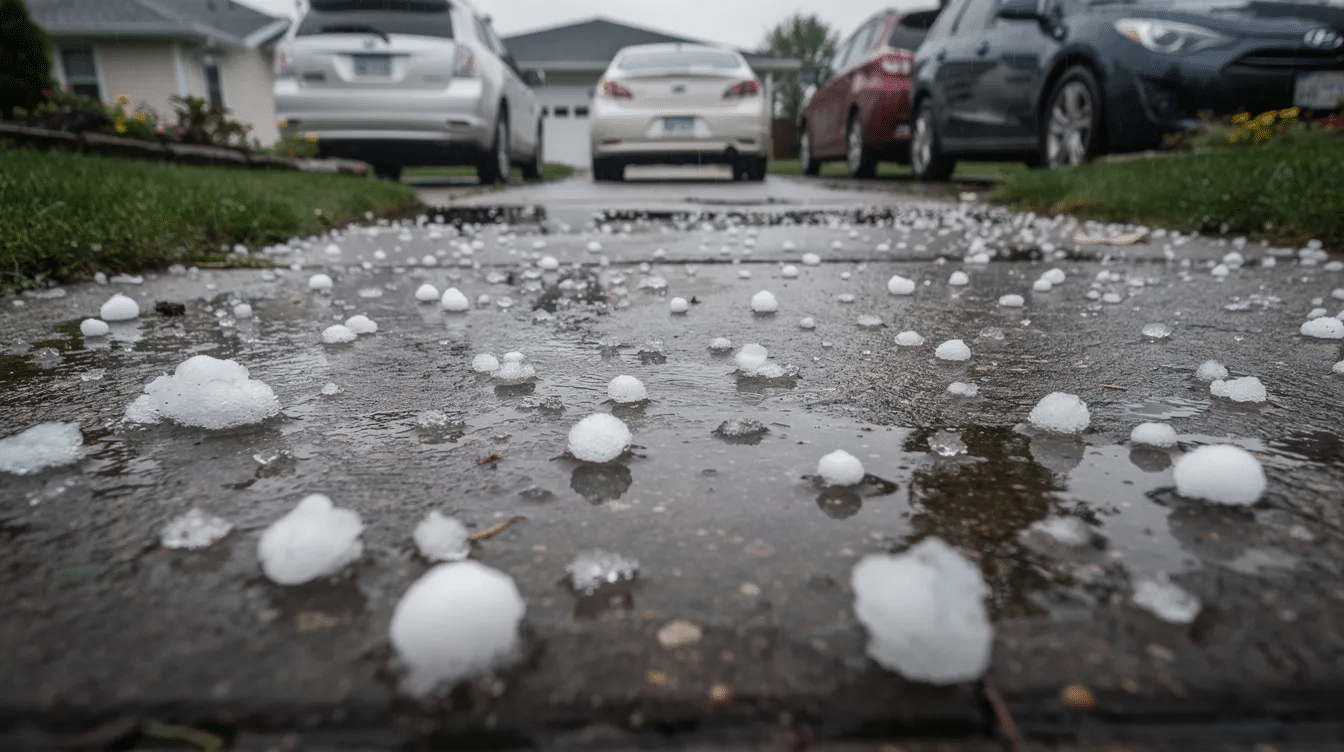
There are several things a homeowner can check safely without climbing a ladder. Start by walking the perimeter after conditions are dry and safe. Look at the home, driveway, landscaping, gutters, fence, cars, and anything else exposed during the storm.
The purpose of this walk-around is not to diagnose every possible roofing problem yourself. It is to identify typical signs that the home took a hard hit and decide whether a professional assessment makes sense.
- Missing shingles. If wind lifted or tore away shingles, you may see an irregular dark area, an exposed section, or roofing pieces in the yard. Missing shingles after a hail storm can also point to combined wind and impact damage.
- Damaged or displaced ridge pieces. Ridge caps sit high on the home and take direct weather exposure. Larger sections may be visible if they have shifted or disappeared.
- Dented gutters. The gutter system is one of the easiest exterior clues to inspect. Fresh circular dents, crushed edges, or marks on the top surface can indicate significant hail impacts.
- Downspout damage. Metal downspouts may show fresh dimples. Plastic components may crack or separate when hit hard enough.
- Damaged siding. Vinyl siding may crack, chip, or break. Painted siding may show fresh impact marks. Metal siding can reveal obvious dents.
- Broken tile pieces. On a tile home, fragments around the perimeter may signal cracked or fractured pieces higher up.
- Granules at drainage points. Small amounts of granules are normal as asphalt shingles age. A sudden, heavy concentration after a hailstorm deserves attention, especially if it appears along with other fresh storm clues.
- Damage around skylights or vents. Larger damaged or displaced components may occasionally be visible, although smaller dents and cracks are usually difficult to judge from below.
If the only thing you see from the ground is a few loose leaves and small branches, that does not automatically mean the home was damaged. On the other hand, if the same walk-around reveals dented gutters, chipped siding, a damaged vehicle, and damaged screens, there is much stronger evidence that the site experienced meaningful impacts.
Should you use binoculars?
Binoculars can help with a basic visual check from a safe location. They may make missing shingles, lifted edges, large dark areas, or fractured tile easier to notice. They are not a substitute for an inspection because distance, roof angle, lighting, shingle color, and surface texture can hide smaller damage.
A cell phone with optical zoom can also help you document what you see, but avoid leaning from upper-story windows or climbing onto patio covers to get a better picture. A storm assessment is not worth a fall.
What about dark spots on shingles?
Dark spots can sometimes show where hail removed protective granules and exposed the darker asphalt beneath. The problem is that algae staining, normal wear, shadows, moisture, manufacturing variation, and older granule loss can look similar from a distance.
If you can see new dark spots after the storm and nearby soft metals have fresh dents, that combination is more meaningful than the shingle appearance alone. A roofing contractor can examine the area more closely and determine whether the marks are consistent with hail, normal wear, mechanical damage, or something else.
Ground-Level Clues of Hidden Hail Damage Around Your Property
The rest of the property can tell a useful story. A storm hits more than the roofing system. It strikes cars, gutters, screens, fencing, outdoor equipment, sheds, patio covers, mailboxes, and landscaping. Those lower surfaces are often easier for a homeowner to inspect safely.
- Cars and trucks: Fresh dents on a hood, roof panel, trunk, or metal trim are a strong clue that the site experienced hard impacts. The same hailstones may have struck the home moments earlier.
- Gutters and downspouts: Look at the top edges and exposed faces. Dented gutters are often easier to identify than shingle bruising.
- Window screens: Torn mesh, fresh holes, bent frames, or damaged solar screens can reveal the direction the storm came from.
- Exterior cladding and trim: Look for chipped paint, cracked vinyl, marks on fascia, and damage around window trim.
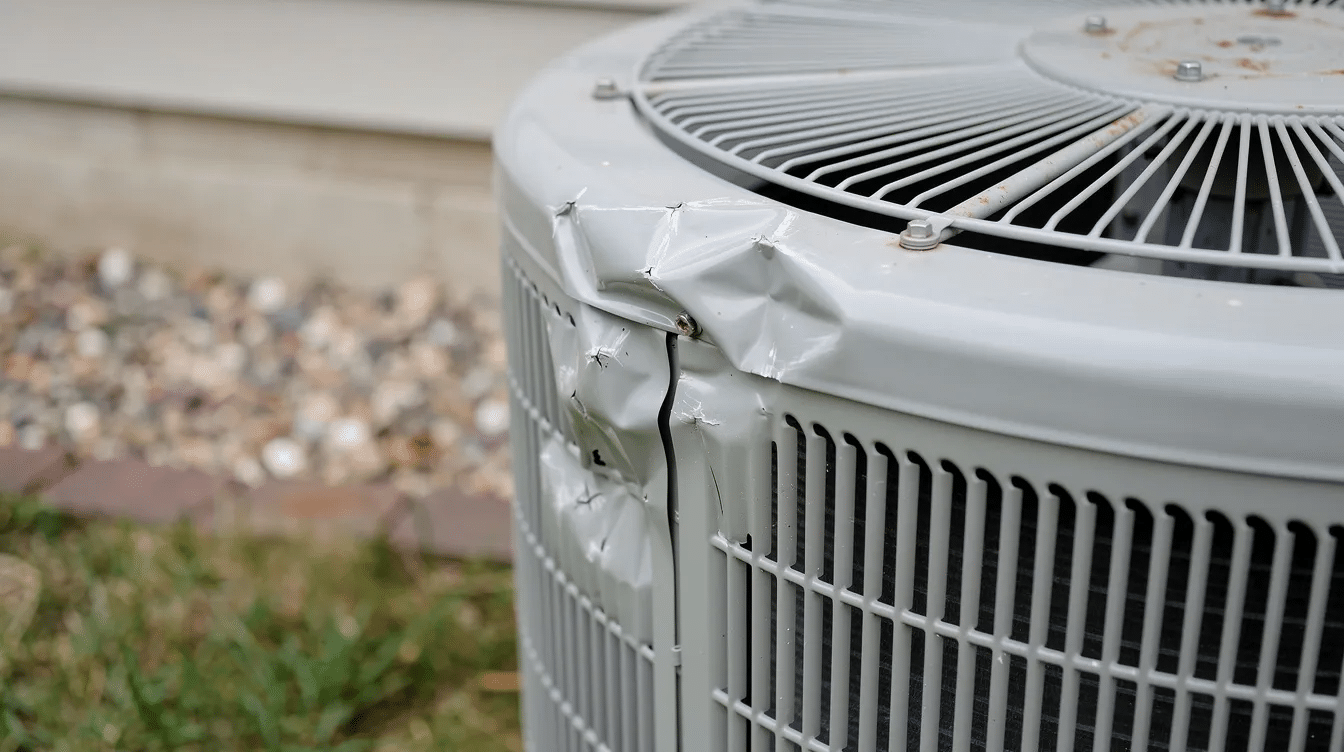
- Outdoor AC units: Check the metal cabinet and condenser fins. Outdoor AC units frequently show dents or bent fins after larger hail.
- Fences: Painted wood and stain can show fresh light-colored impact marks. Vinyl fence panels can crack. Metal posts and caps may dent.
- Outdoor furniture: Plastic pieces can crack, painted metal can chip, and fabric covers can tear.
- Sheds and carports: Thin-gauge metal roofs may reveal dents more clearly than the main home.
- Garage doors: Aluminum panels and trim can show repeated dings after a hailstorm.
None of those clues alone proves damage to your roof. They help establish the intensity and direction of the storm at your specific home. A car with no dents does not guarantee the shingles are fine, and a dented mailbox does not prove the roofing system needs replacement. Think of the clues as pieces of the same puzzle.
Granule accumulation in gutters: what it does and does not mean
Granule loss gets a lot of attention after hail because asphalt shingles rely on those mineral granules to protect the asphalt from sunlight and weather. Hail impacts can dislodge protective granules. So can age, foot traffic, manufacturing variation, tree abrasion, and normal weathering.
After a recent storm, look for an unusual amount of dark, sand-like material collecting where downspouts discharge or at accessible gutter outlets. If you normally do not see much granule accumulation and suddenly find a heavy concentration after hail, document it.
Do not treat granules by themselves as proof of an insurance loss. A professional roofer should compare the drainage evidence with the condition of the shingles, soft metals, vents, and other components before drawing a conclusion.
Why outdoor AC damage deserves attention too
Homeowners sometimes focus so heavily on the home that they forget mechanical equipment. Hail can bend the thin aluminum fins around an outdoor condenser coil. Severe impacts can damage fan guards, cabinet panels, and other exposed parts.
If you find fresh AC damage, photograph it and consider having the system checked by an HVAC professional. A roofing company should inspect the roofing system; an HVAC contractor should evaluate mechanical performance. Keeping those roles separate gives you a cleaner record of what each specialist observed after the storm.
What You Usually Cannot See from the Ground (But Matters Most)
The harder question is not what you can see. After a hailstorm, the greatest risk is often assuming that no visible problem means no storm damage. It is what may be too subtle to recognize without close inspection.
Composition shingles are built in layers. The mineral granules on top protect the asphalt coating, while the reinforcing mat provides structure. A hail impact can disturb the surface granules, compress the asphalt beneath them, and in some cases contribute to cracking or fractures within the shingle. The shingle may remain in place and still shed water initially.
That is why leaks are a poor screening test immediately after a storm. A house can have no interior water stains the next morning and still have damaged components that need attention. Conversely, a home can also have no meaningful hail damage at all. The only responsible answer comes from looking at the actual condition of the materials.
Bruised asphalt shingles
A bruise is an area where impact has compressed or disturbed the asphalt and granule layer. Some bruises are obvious up close. Others are subtle. They may appear as a darker spot, a slight depression, or an area where granules have been displaced.
Roofing professionals also look at the pattern. Random impacts across a slope are different from straight-line scuffs caused by foot traffic or mechanical abrasion. That distinction matters because not every mark on a shingle is hail damage.
Older shingles deserve particular attention. San Antonio heat can age asphalt over time, making older materials more brittle and less forgiving. The same storm may affect a 15-year-old roof differently from a newer one.
Cracked shingles and fractured reinforcement
Cracked shingles may be easy to see when a crack is large and near the lower edge, but smaller fractures can hide within a field of otherwise normal-looking material. Strong impacts can also affect the internal mat without leaving a dramatic hole.
This does not mean every hailstone fractures fiberglass reinforcement. The likelihood depends on stone size, hardness, wind speed, roof age, slope, material condition, and the point of impact. A professional inspection is meant to separate true impact damage from ordinary aging.
Roof vents, flashing, pipe boots, and soft metals
Vents are useful indicators because many contain thin metal surfaces that show dents clearly at close range. Flashing around chimneys, walls, skylights, and other transitions can also show impact marks or deformation.
Pipe boots deserve a careful look because the rubber or flexible collar around a plumbing vent can split, crack, or pull away. Those failures may be small, but they create a direct path for water intrusion around a penetration.
Dented flashing does not automatically require replacement. The question is whether the metal still performs its intended function or whether the impact opened a seam, loosened fasteners, cracked a seal, or changed drainage.
Underlayment and decking problems are usually secondary
Hail does not normally reach the roof deck unless the outer materials are punctured or broken. The bigger concern is what can happen later if damaged roofing materials allow moisture to enter.
Repeated moisture entry can wet underlayment, decking, insulation, and framing. Left alone long enough, moisture can contribute to rot, staining, and mold growth. That is why homeowners should not wait for obvious interior water damage before investigating known exterior impacts.
How Hail Size and Roof Type Affect What You Can See
Stone diameter matters, but there is no universal size at which every roofing material suddenly fails. A hard one-inch hailstone driven by strong wind can be more damaging than a softer stone falling in calmer air. Roof age, temperature, pitch, installation quality, and material type all change the outcome.
| Approximate Hail Size | Common Comparison | What You May Notice |
|---|---|---|
| Under 1 inch | Pea to nickel | Often little obvious exterior damage; softer metals or older materials may still show marks. |
| About 1 inch | Quarter | Dents may appear in gutter runs, downspouts, vents, or vehicles; shingle effects can still be difficult to identify from a distance. |
| About 1.5 inches | Ping-pong ball | More noticeable dents on soft metals and vehicles; greater risk to older or weathered shingles. |
| About 1.75 inches | Golf ball | Higher potential for serious damage to shingles, metal components, exterior walls, screens, and cars. |
| 2 inches and larger | Hen egg and above | Greater potential for cracked shingles, fractured tile, damaged vents, punctures, and widespread exterior damage. |
Friday night’s hail storm in San Antonio included reports from quarter size up to golf-ball size in parts of eastern Bexar County. That range is large enough to justify concern where a property was directly in the hail core, especially if the home also shows fresh dents, damaged screens, or damaged landscaping.
Asphalt shingles
Shingle roofing is common across San Antonio. They can lose granules, bruise, crack, or tear depending on the force of impact. Their dark, textured surface makes small impact marks hard to identify from a distance, which is why a roof inspection is more useful than a quick look from the sidewalk.
Class 4 shingles are impact-resistant roofing materials tested to a higher laboratory standard than many conventional products. That does not make them hail-proof. It means the product has demonstrated stronger impact performance under a defined test method. People replacing a storm-damaged roof may want to ask a roofing contractor whether an impact-resistant shingle makes sense for their budget and insurance situation.
Metal roofing
Metal roofing reacts differently. Hail may leave cosmetic dings without compromising water-shedding performance, or it can damage seams, coatings, fasteners, flashings, and panels in a more functional way.
The distinction matters. A dent is not automatically a leak, but widespread deformation around seams or penetrations can be more important than appearance alone. A professional roofer familiar with standing-seam and other metal systems should evaluate whether the issue is cosmetic, functional, or both.
Clay and concrete tile
Tile can perform well in hail, but large impacts may crack corners, break individual pieces, or create fractures that are difficult to identify without close access. You should never walk tile yourself after a storm. Stepping in the wrong place can break otherwise serviceable pieces and create damage that was not there before.
Tile fragments around the home are an obvious clue. The absence of fragments does not rule out cracks higher on the slope.
Older roofing materials
Age changes everything. Years of sunlight, thermal expansion, rain, wind, foot traffic, and normal weathering can make an older roof vulnerable to impacts that a newer system might handle better.
This is one reason two neighboring homes can receive the same size hail and have very different outcomes. One may need only a minor repair, while the other has widespread damage. Material condition matters as much as the weather report.
Do hail guards and drainage systems prevent hail damage?
Some protective products can reduce specific risks, but homeowners should be careful with broad claims. Guards or protective cages may help shield certain equipment, skylights, or vulnerable components. Impact-resistant roofing materials may also improve performance. None of these makes an entire home immune to hail.
Efficient drainage is important after a storm, but gutters do not stop impact damage. Clean drainage components help move rainwater away after roofing materials have been stressed, reducing the chance that backed-up water adds another problem. They protect the drainage side of the system rather than preventing hailstones from striking the roof.
Safe DIY Checks vs. When to Call Ja-Mar Roofing & Sheet Metal
There is a useful line between checking your property and trying to perform your own roof inspection. You can do a lot safely from the yard. Climbing onto a wet, steep, tile, or storm-damaged roof is different.
Safe checks homeowners can do
- Walk the property after lightning, strong winds, and heavy rain have passed.
- Photograph fresh dents, damaged screens, damaged fencing, exterior cladding, cars, and outdoor equipment.
- Look for roofing pieces, shingle fragments, or fractured tile in the yard.
- Check accessible gutter outlets for an unusual amount of granules.
- Use binoculars or a phone camera from a stable location to look for obvious missing shingles.
- Check ceilings, attic areas, and upper walls for new stains, dampness, or active leaks.
- Record the date and approximate time of the storm while it is still fresh.
Do not use a ladder simply because a contractor or insurance company may want pictures. You do not need to put yourself at risk to document a loss. A trained roofing contractor has fall-protection equipment, ladders, footwear, and experience moving across different roofing materials.
When a professional inspection makes sense
Consider scheduling a roof inspection when any of the following applies:
- Quarter-size or larger hail was reported near your property.
- Your vehicle or gutter components have fresh dents.
- You have cracked siding, damaged screens, or damage to exterior condensers.
- You can see missing shingles, fractured tile, or damaged vents.
- The home has an older roof and was directly in the storm path.
- You heard repeated hard impacts during the storm but cannot tell what happened afterward.
- You notice a new leak, ceiling stain, attic moisture, or musty odor.
- Neighbors on the same block are discovering verified storm damage.
A professional assessment should answer a simple question first: what roof damage is actually present? It should not begin with the assumption that a replacement is necessary.
Ja-Mar Roofing & Sheet Metal has served Texas property owners for decades and provides roof inspection services in the San Antonio area. The inspection should document the condition of shingles, flashing, valleys, vents, penetrations, gutters, and other relevant components. If there is no meaningful hail damage, you should be told that. If repair is appropriate, the recommendation should match the actual scope of the problem.
What a roofer actually checks after a hail storm
A close roof evaluation is systematic. The inspector should look at each roof slope rather than stopping after finding one mark. The roof edge, ridge, valleys, penetrations, flashing, and field areas all tell part of the story. Damage to your roof may be concentrated on the side that faced the storm, while another roof plane shows little effect.
On a shingle roof, the inspector looks for a pattern of impacts, displaced granules, bruising, cracks, lifted tabs, and wind-related movement. On a tile roof, the focus shifts toward fractured pieces, corner breaks, displaced tiles, and exposed underlayment. On a metal roof, seams, coatings, flashings, and attachment points matter as much as cosmetic dents.
The roof also needs to be considered as a system. A sound roof surface does not help much if a penetration was damaged, and a dented accessory does not automatically mean the entire roof failed. The purpose of the roof inspection is to determine what actually changed, document the roof condition, and decide whether that change affects performance.
If there is damage to your roof, the recommendation should match the scope. One repairable area should not automatically become a full replacement. Widespread damage to your roof is a different situation, especially when the roof is older or the same hailstorm affected multiple slopes. That is where an experienced contractor can explain the practical options without turning every hail storm into the same sales pitch.
These are the signs a professional should document clearly so the San Antonio home owner has a useful record even if no immediate work is required. Severe weather can wreak havoc on one block and barely touch the next, which is why a property-specific evaluation matters.
What a useful storm inspection should document
A quality inspection is more than a few random photos. It should establish where damage was observed and what type of component was affected.
- Overall condition of each accessible slope
- Impact marks on shingles or other roofing materials
- Missing shingles or wind-lifted areas
- Granule loss patterns
- Condition of ridge caps
- Dents or damage to vents
- Flashing and penetration details
- Gutters and downspouts
- Tile cracks or fractured pieces where applicable
- Interior evidence of water intrusion if present
Photos should show both context and detail. A close-up is useful for identifying a specific mark, while a wider image helps show where that mark sits on the structure. That kind of documentation is helpful whether the next step is maintenance, repair, monitoring, or an insurance claim.
Why visible damage is only part of the story
The common signs after a hailstorm are useful because they tell you where to look, but they do not show every condition on the roof surface. Hail can bruise shingles without tearing them away, and a second impact can bruise shingles in a different pattern on another slope. Large ice stones can damage roofing materials while the street-facing side of the home still looks normal.
If you find downspouts cracked by impact, fresh dents in soft metal, or branches falling onto the roofline during the storm, document those details. They can help a professional roofer understand how the weather moved across the site. The larger concern is whether the event changed the structural integrity or water-shedding performance of any component.
Those signs do not mean you automatically need replacement. They mean the home deserves a professional assessment. A careful evaluation is especially worthwhile when roof hail damage is suspected but not visible from the ground, or when you notice new leaks after the hailstorm.
Insurance Coverage, Documentation, and Next Steps After Hail Damage
Many Texas homeowners insurance policies include coverage for wind and hail, but deductibles, exclusions, settlement methods, cosmetic damage provisions, and claim requirements vary. Your insurance coverage depends on the language in your own policy, so two neighboring homes may have different outcomes after the same storm. Some policies use a separate wind and hail deductible. Others may have different terms for actual cash value versus replacement cost coverage.
Before opening an insurance claim, the safest advice is to read your own policy or speak directly with your insurance company. Do not assume a neighbor’s coverage works the same way simply because both homes were hit by the same hailstorm.
Do Texas homeowners have 12 months to file a hail claim?
There is not one universal 12-month rule that applies to every Texas homeowner policy. The Texas Department of Insurance advises policyholders to notify their insurer as soon as possible because companies may set filing deadlines. Some policies have a one-year deadline unless there is good cause for delay, and Texas Windstorm Insurance Association policies generally use a one-year deadline from the date of damage.
That distinction matters. Rather than relying on a generic internet rule, check the notice and filing provisions in your policy. Prompt documentation is useful regardless of the deadline because it helps connect observed storm impacts to a specific storm date.
Steps to document storm damage
- Record the date and time. For the current event, note Friday, September 11, 2026, and the approximate time the storm moved through your neighborhood.
- Photograph accessible property damage. Take clear pictures of vehicles, siding, drainage components, fencing, screens, outdoor furniture, and AC condensers.
- Do not make permanent repairs before the carrier has had an opportunity to inspect when a claim is involved. Temporary measures may be necessary to protect the property from further damage.
- Save receipts. Keep records for emergency tarping, temporary repairs, water cleanup, or other necessary expenses.
- Schedule a professional inspection. A local roofing company can document what it observes on the roofing system.
- Contact your insurance company if you believe covered damage occurred. The carrier determines coverage under the policy.
- Keep your documents together. Save photos, inspection notes, estimates, carrier correspondence, claim numbers, and receipts in one folder.
What a roofing contractor can and cannot do during the claims process
A roofing contractor can evaluate the property, identify observed damage, prepare a repair or replacement estimate, document the scope of roofing work, and answer construction questions. The insurance company determines whether the policy provides coverage and what it will pay under the contract.
This separation is important during the claims process. Insurance policies are contracts, and coverage decisions should come from the carrier or another properly licensed insurance professional. For the roofing portion, the contractor should stay focused on what is physically present and what work is required. You want the roofing company focused on the physical condition of the home and the work required to repair it correctly. Coverage questions belong with the insurer or, when appropriate, a licensed insurance professional.
Temporary repair after a severe storm
If the storm opened the roofing system, do not wait for a full claim decision before taking reasonable steps to protect the property. A missing section, puncture, damaged skylight, or active leak may need temporary tarping or another emergency repair.
Take photos before the temporary work when it is safe to do so, keep receipts, and avoid permanent changes that could remove evidence before the insurance company has an opportunity to inspect. Your policy may require you to prevent additional damage, and timely temporary work can help protect insulation, drywall, flooring, and belongings from further water damage.
Why Partner with a Local Roofing Company After a San Antonio Hail Storm
Large storms bring a predictable second wave into Texas neighborhoods: contractors. Some are established local companies. Others arrive from outside the region, work the storm for a few weeks or months, and move on.
You do not need to assume an out-of-town contractor is automatically bad, but there is value in knowing who will be available after the job is complete. Hail damage repair is not only about installing materials. It involves inspection, documentation, communication, scheduling, permitting when required, cleanup, warranties, and the ability to return if something needs attention later.
What to look for in a roofing contractor
- Established local presence. Verify where the company operates and how long it has served the area.
- Insurance. Ask for current proof of general liability and workers’ compensation coverage where applicable.
- Manufacturer credentials. Certifications can show additional product training and may provide access to enhanced warranty options.
- Recent local reviews. Look for detailed feedback from homeowners in the San Antonio area, not only a high star rating.
- Written scope. A professional proposal should explain the materials, quantities, ventilation, flashing, underlayment, cleanup, and warranty rather than giving one vague price.
- No deductible games. Texas law requires insureds to pay applicable deductibles. Be cautious of anyone promising to waive or absorb a deductible through questionable discounts.
- No pressure to sign immediately. A reputable contractor should be able to explain what was found and give the homeowner time to understand the next step.
Ja-Mar Roofing & Sheet Metal has served Texas since 1970 and works throughout greater San Antonio. For homeowners affected by the September 11 hailstorm, the first step does not have to be a sales decision. It can simply be a free roof inspection to determine whether the home actually sustained storm damage.
If the inspection finds a small repair, address the repair. If it finds no meaningful impact damage, keep the documentation with your home records. If the condition is more extensive, you will have clearer information before deciding how to move forward.
Why local storm knowledge matters
A contractor who regularly works in San Antonio sees the same roofing materials, heat exposure, neighborhood construction styles, and recurring severe weather patterns year after year. That experience helps when distinguishing old wear from fresh storm damage.
It also helps with practical details. Homes in Stone Oak may have steep, complex rooflines. Alamo Ranch includes many large two-story homes. Older neighborhoods closer to central San Antonio may have roofs that have been repaired or replaced several times. Tile is common on many higher-end and Mediterranean-style homes. Metal roofing continues to appear on both new construction and custom homes.
The storm does not affect every roof type the same way. A local roofing company should know how to evaluate those differences instead of using one checklist for every home.
Property managers dealing with hail damage on larger properties can also review our guides to commercial roof hail damage and multifamily hail damage for inspection considerations specific to those types of buildings.
FAQ: San Antonio Hail Damage You Can’t See from the Ground
How soon after a hail storm should I have my roof inspected in San Antonio?
You do not need to panic or have someone on the home within hours. Start with a safe property check once the weather clears. If you find dented gutters, car dents, damaged exterior cladding, damaged screens, missing shingles, or other fresh signs, schedule a roof inspection within the next several days. The same advice applies if quarter-size or larger hail was confirmed near your neighborhood.
A timely inspection gives you a condition record close to the storm date and helps identify repair needs before another rain event. It also lowers the risk of small openings turning into leaks or contributing to mold growth after repeated moisture exposure. It also prevents the common situation where a homeowner discovers a leak months later and has difficulty determining exactly when the exterior problem began.
Will my roof always leak immediately if it has hail damage?
No. Some serious damage creates an immediate leak, but many impact problems do not. A bruised or cracked shingle can continue shedding water for a period of time before weathering enlarges the weak area. Damaged flashing or a pipe boot may also leak only when rain hits from a particular direction.
The absence of leaks is good news, but it is not a complete storm assessment. The same is true in reverse: a leak after a hailstorm does not automatically mean hail caused it. Flashing failures, aging sealants, wind damage, and pre-existing defects can all produce water intrusion.
Can I rely on my neighbor’s inspection to decide if my house is okay?
No. Hail patterns can be remarkably localized. Roof age, slope direction, tree cover, material type, and maintenance history also vary from house to house.
If the neighbor’s home has damage, it tells you the storm had enough energy to affect nearby property. It does not prove your home has the same problem. Have your own property evaluated when you have reason for concern.
Do I have to wait for my insurance company before calling a roofing company?
No. You can have a roofing contractor inspect the property before deciding whether to file an insurance claim. In many cases, that is helpful because it answers the basic question of whether observable roofing damage exists.
If the inspection finds no meaningful storm damage, you may not need to take the issue further. If it finds damage, you can review your policy, deductible, and next steps with your insurance company. The contractor can provide photos and a construction estimate, while the insurer makes coverage decisions.
How often should I have my roof inspected if my area gets multiple hail storms each year?
There is no single schedule that fits every home. An annual evaluation is reasonable for many properties, especially older systems, and an additional inspection can make sense after a severe event that produced severe hail or obvious property damage.
Regular evaluations also create a useful history. If an inspection from last year shows a clean roof and a new inspection documents fresh impact marks after a specific storm, the homeowner has a much clearer timeline.
What size hail can damage a roof?
There is no magic diameter that guarantees damage. Quarter-size hail is commonly treated as a threshold for increased concern, but material condition and wind matter. Golf-ball-size hail creates a much greater risk, especially on older shingle systems, tile, skylights, vents, and soft metals.
For a deeper explanation of hail size, roof age, and different materials, see what kind of hail can damage a roof.
What are the most common signs of hail damage on asphalt shingles?
Common signs include localized granule loss, dark impact spots, bruising, cracks, tears, and damage around edges or ridge caps. Some marks are easy to see up close but blend into the shingle color from a distance.
Not every dark mark is hail. Blistering, aging, manufacturing variation, foot traffic, tree abrasion, and mechanical damage can look similar. Pattern, location, material condition, and surrounding evidence all matter.
Can hail damage metal roofing without causing a leak?
Yes. Metal systems can develop cosmetic dents while remaining watertight. Functional damage is more concerning when impacts affect seams, panel locks, fasteners, penetrations, coatings, or flashing.
The correct response depends on the system and the location of the dents. A contractor familiar with metal roofing should determine whether the issue is cosmetic only or whether repair is needed.
Can hail damage roof vents and flashing?
Yes. Roof vents, flashing, chimney caps, and other soft-metal components can show dents and deformation. These areas are useful inspection points because they often record impacts more clearly than textured shingles.
A dent itself does not always mean the component has failed. The professional assessment should determine whether seams, fasteners, seals, or drainage were affected.
What should I do if I find missing shingles after the storm?
Photograph the affected area from a safe location and schedule a repair evaluation. Missing shingles can expose underlayment to sunlight and rain, and the surrounding material may also have been loosened by high winds.
If rain is expected and the exposed area is significant, ask about temporary protection. Avoid trying to climb up with a tarp unless you have the equipment and training to do it safely.
Does granule loss always mean hail damage?
No. Granule loss occurs naturally as asphalt shingles age and can also result from installation, foot traffic, tree contact, and ordinary weathering. Fresh hail can accelerate granule loss, particularly at impact points.
The important question is whether the amount, pattern, and timing are consistent with the recent storm. Granules in a downspout plus new dents on gutter systems and cars tell a stronger story than granules by themselves.
Can hail damage exterior cladding even if the roof is fine?
Yes. Different materials react differently to the same impact. Vinyl siding may crack while newer impact-resistant shingles remain serviceable. Wind direction also matters because one wall may take repeated impacts while a roof slope sits at a less damaging angle.
This is another reason not to use one damaged component as automatic proof about another. Document all property damage, then have each system evaluated appropriately.
Should I inspect my outdoor AC unit after hail?
Yes. Look for visibly bent fins, dented metal panels, or damage to the fan guard. Do not open the unit or attempt mechanical repairs unless you are qualified.
If the condenser shows significant damage or is not cooling correctly after the storm, contact an HVAC professional. Photos of the exterior condition can also be useful if you file an insurance claim involving multiple parts of the property.
Can a roof inspection tell the difference between old damage and new hail damage?
Often, an experienced inspector can distinguish fresh damage from older wear by looking at weathering, oxidation, granule condition, exposed material, sealants, and the pattern of impacts. It is not always possible to date every mark precisely, which is why prior inspection photos and maintenance records are valuable.
Fresh dents on metal may have bright, unweathered surfaces. Newly exposed asphalt may look darker than surrounding aged material. Older damage tends to weather and blend over time.
Will Class 4 shingles prevent hail damage?
No roofing product is hail-proof. Class 4 shingles are tested for higher impact resistance and may perform better than standard products under many conditions, but very large or wind-driven hail can still cause damage.
If you are replacing an older roof after a storm, ask whether an impact-resistant product makes sense for your home. Also ask your insurance company whether it offers any premium consideration for qualifying materials, because programs vary by carrier.
Does a dented gutter mean I need a new roof?
No. Dented gutters show that the site experienced impact, but the roofing system must be inspected on its own. It is entirely possible to have gutter dents with little shingle damage, especially with newer impact-resistant materials.
Use the gutter damage as a reason to investigate, not as a replacement verdict.
Can a small hailstorm cause significant damage?
It can under the wrong combination of conditions. Hail size, hardness, wind speed, roof age, material quality, slope, and existing wear all influence the outcome.
Small hail is less likely to cause significant damage than large hail, but an older, brittle roof may be more vulnerable. Large hail and high winds create the greatest concern because impact energy increases and stones can strike at an angle.
What should I do if my roof looks fine after the September 11 San Antonio hailstorm?
If the home looks fine and you see no exterior clues anywhere on the property, there may be no damage. Keep an eye on the home during the next rain and save the storm date in your records.
If nearby homes, cars, gutters, siding, or outdoor equipment show fresh dents or breakage, schedule a professional inspection even if the shingles look normal from the driveway. The purpose is to verify the condition, not to assume a repair or replacement is necessary.
Where in San Antonio was hail reported on September 11, 2026?
Reports from the Friday night storm included portions of eastern Bexar County around Converse, Kirby, Saint Hedwig, China Grove, and nearby communities. Some reports described hail from around one inch to 1.5 inches, with golf-ball hail reported in the Paloma subdivision near Converse.
Storm cores can be narrow, so a citywide report does not tell you exactly what happened at your address. If you live in an affected area, your own site clues and a local inspection are more useful than a broad metro hail map by itself.
Who should San Antonio residents call for a free roof inspection after hail?
Choose an established local roofing company that can document what it finds, explain whether the condition calls for monitoring, repair, or replacement, and provide a written scope when work is needed.
Ja-Mar Roofing & Sheet Metal has served Texas homeowners since 1970 and provides free roof inspections throughout the San Antonio area. If your property was in the path of the September 11 storm, especially around Converse, Kirby, Saint Hedwig, China Grove, or the east side, an inspection can help you find out what happened without trying to judge the entire roofing system from the driveway.
For people who need repair information, visit our San Antonio roof repair page. For broader local roofing services, visit Ja-Mar Roofing & Sheet Metal’s San Antonio roofing page. You can also review our guide to hidden hail damage signs if you want a deeper look at less obvious impact patterns.

