
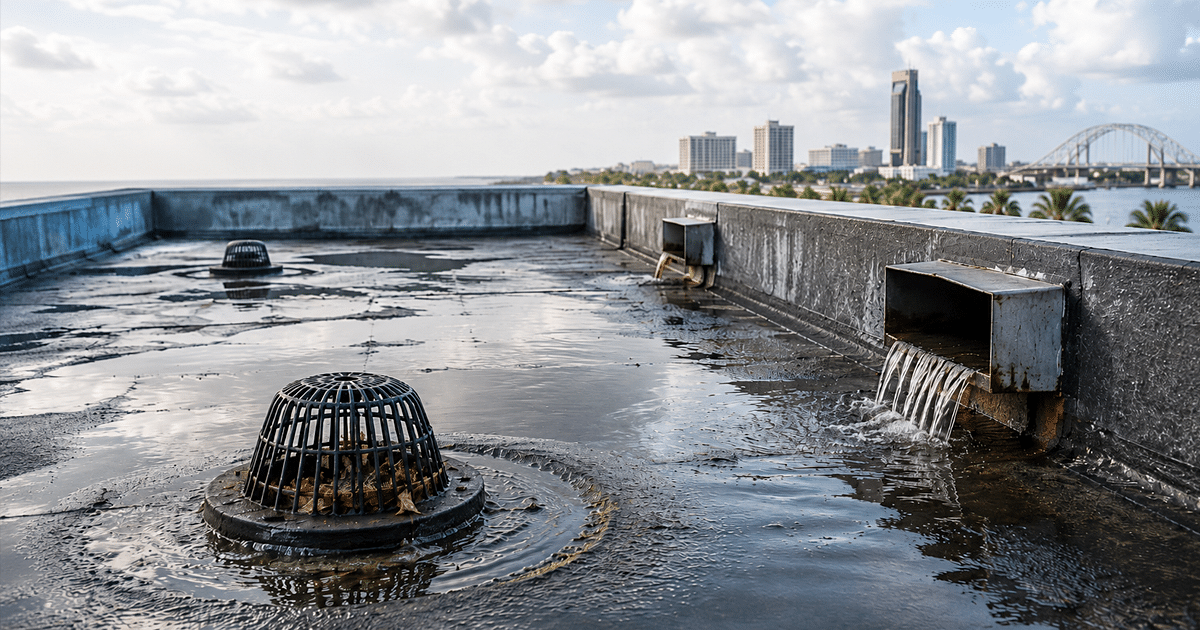
Ponding water on a commercial roof is one of the most common and most overlooked problems building owners face in Corpus Christi. Commercial Roof Drainage Problems in Corpus Christi often start with clogged drains, undersized scuppers, or low spots that keep water from moving off the roof properly. Between Gulf storms, salt air, and wind-blown debris, local flat roofs take a beating that inland buildings never see. This guide covers why ponding water forms, how drains and scuppers are supposed to prevent it, what goes wrong, and what to do when your roof holds water long after the rain stops.
Key Takeaways
Ponding water on flat and low-slope commercial roofs in Corpus Christi is not “normal.” A properly designed drainage system should clear a roof surface within 24 to 48 hours after a storm. Water that remains in the same spot past the 48-hour mark is classified as ponding water by roofing manufacturers, inspectors, and the International Building Code. It indicates a drainage failure that needs evaluation.
The most common causes of ponding water include:
- Clogged drains and scuppers from leaves, palm fronds, and wind-blown debris
- Insufficient roof slope (below the ¼-inch-per-foot minimum used for many new low-slope roofing systems)
- Compressed insulation from foot traffic or stored equipment
- Structural deflection or deck settling in older buildings
- Rooftop equipment additions that block water flow paths
Prolonged standing water damages every type of commercial roofing system. TPO, PVC, modified bitumen, coatings, and metal roof components all deteriorate faster under chronic ponding, leading to leaks, wet insulation, deck rot, and premature replacement. Ponding water poses a serious threat to commercial structures because even shallow accumulation over a large area adds thousands of pounds of dead load.
What building owners should do:
- Walk the roof after storms and look for standing water, algae rings, stained membrane, rusted metals, and interior leaks
- Schedule commercial roof maintenance and drain cleanings at least twice per year, including before hurricane season and again ahead of peak late-summer and fall tropical weather
- Track ponding locations with photos and simple roof maps year over year
- Call a roofing professional when water persists past 48 hours or when visible damage appears around drains and scuppers
Complex drainage issues require evaluation by an experienced local contractor. Ja-Mar Roofing & Sheet Metal can investigate and correct drainage problems on commercial roofs throughout the Corpus Christi area.
How Ponding Water Starts on Commercial Roofs (Quick Answer)
Ponding water on a commercial roof happens when drainage is blocked, undersized, or the roof has low spots that prevent water from reaching drains and scuppers. Any water that remains longer than 48 hours after rain is a warning sign that should not be ignored. Clogged drains are a top cause of ponding water on roofs, but poor slope, compressed insulation, and corroded drainage components all contribute.
Flat roofs are not actually flat. They are low slope roofs designed for positive drainage, with many new low-slope roofing systems built with a minimum slope of ¼ inch per foot toward outlets. That design can erode over time as insulation compresses, equipment is added, or the building settles. A roof that worked fine for a decade can start holding water after a single change to its slope profile or drainage layout.
In Corpus Christi, sudden heavy downpours, wind driven rain, and salt-corroded drain components frequently push a marginal drainage design past its limits. Wind-blown debris can quickly accumulate and block roof drainage systems during a single storm event.
Ignoring ponding water leads to:
- Accelerated membrane wear from UV exposure through trapped moisture
- Higher leak risk at seams, flashing, and penetrations in ponded zones
- Saturated insulation that loses thermal performance and adds load to the structure
- Potential structural overload on older roof sections where deep water accumulates over large areas
Why Corpus Christi Commercial Roofs Struggle With Drainage
Corpus Christi sits on the Gulf Coast, exposed to a combination of rainfall intensity, salt air, humidity, and wind exposure that creates unique stress factors for commercial roofing systems. These conditions don’t just cause drainage issues; they accelerate them.
The city averages about 31.7 inches of rain per year, but that number understates the problem. Much of that rain arrives in concentrated bursts during thunderstorms and tropical systems that can drop several inches per hour. A drainage system sized for moderate showers may fail during a two-hour downpour, and that failure results in water pools across wide roof sections.
Wind-blown debris is constant. Palm fronds, live oak leaves, rooftop gravel, and airborne trash from Gulf winds clog drains and scuppers between maintenance visits. Buildings near Corpus Christi Bay, Portland, and Padre Island see the worst accumulation because of sustained wind exposure.
Salt air and humidity in coastal regions accelerate corrosion of drainage components. Metal roof drains, scupper boxes, bolts, and strainers exposed to frequent salt air can corrode faster than comparable components in less salty inland environments, especially when made from standard galvanized steel. Corroded components leak, collapse, or restrict flow without any visible surface warning.
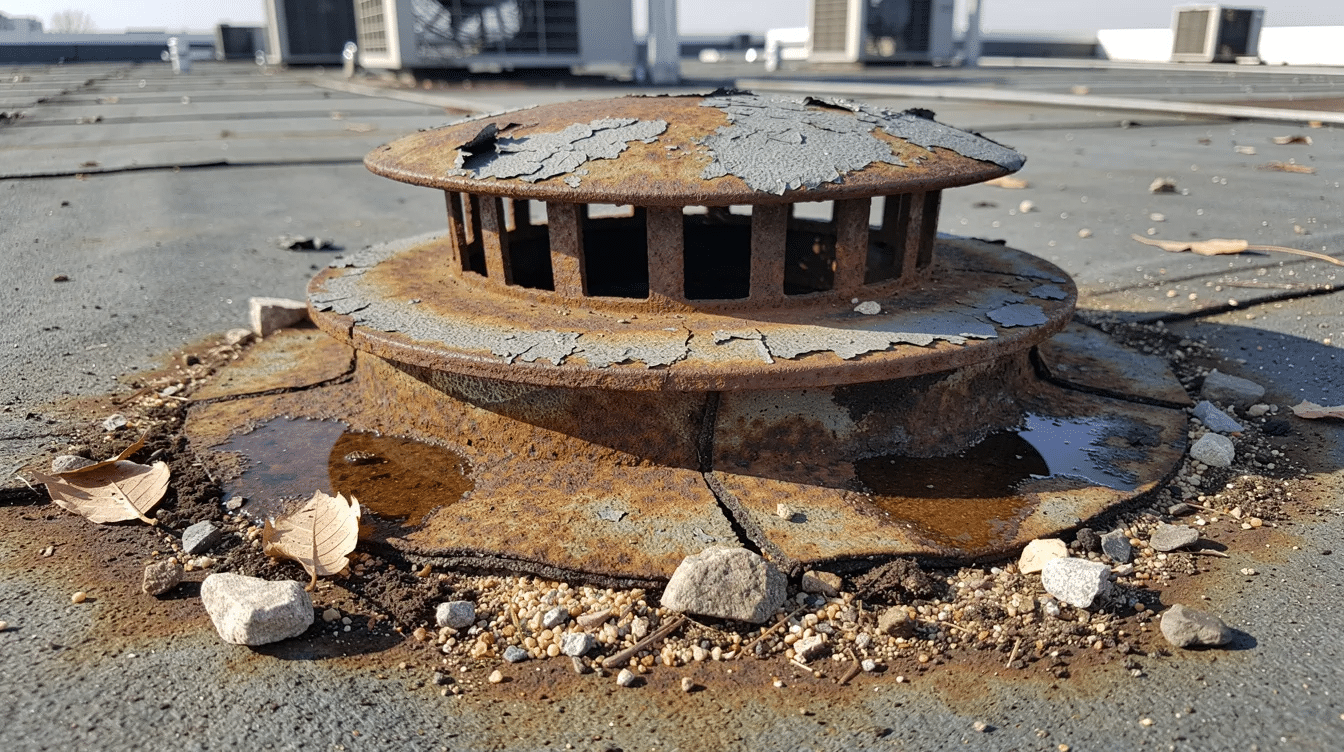
Many Corpus Christi commercial buildings, including warehouses along I-37, shopping centers on SPID, and industrial facilities near the Port, use extensive low slope roofs. On a 50,000-square-foot roof, even a quarter-inch deviation from designed slope creates a ponding zone measured in hundreds of square feet. Humidity and prolonged damp conditions keep those areas wet, promoting algae growth, blistering, and seam deterioration on the roof membrane.
All of this makes routine maintenance and regular inspections of drainage systems more critical in Corpus Christi than in inland markets where roofs dry faster and corrode slower.
How Flat and Low-Slope Commercial Roof Drainage Systems Are Supposed to Work
Understanding what a working drainage system looks like helps commercial property owners spot problems before they turn into leaks. Here is how each component is designed to function.
Positive drainage means the roof surface is built or corrected so water naturally flows toward outlets rather than pooling against parapet walls, equipment curbs, or in the middle of roof sections. Positive drainage should dry roofs within 24 to 48 hours after rain. For many new low-slope roofing systems, flat roofs require a minimum slope of ¼ inch per foot, though some existing reroofs may qualify for exceptions when positive drainage is already provided.
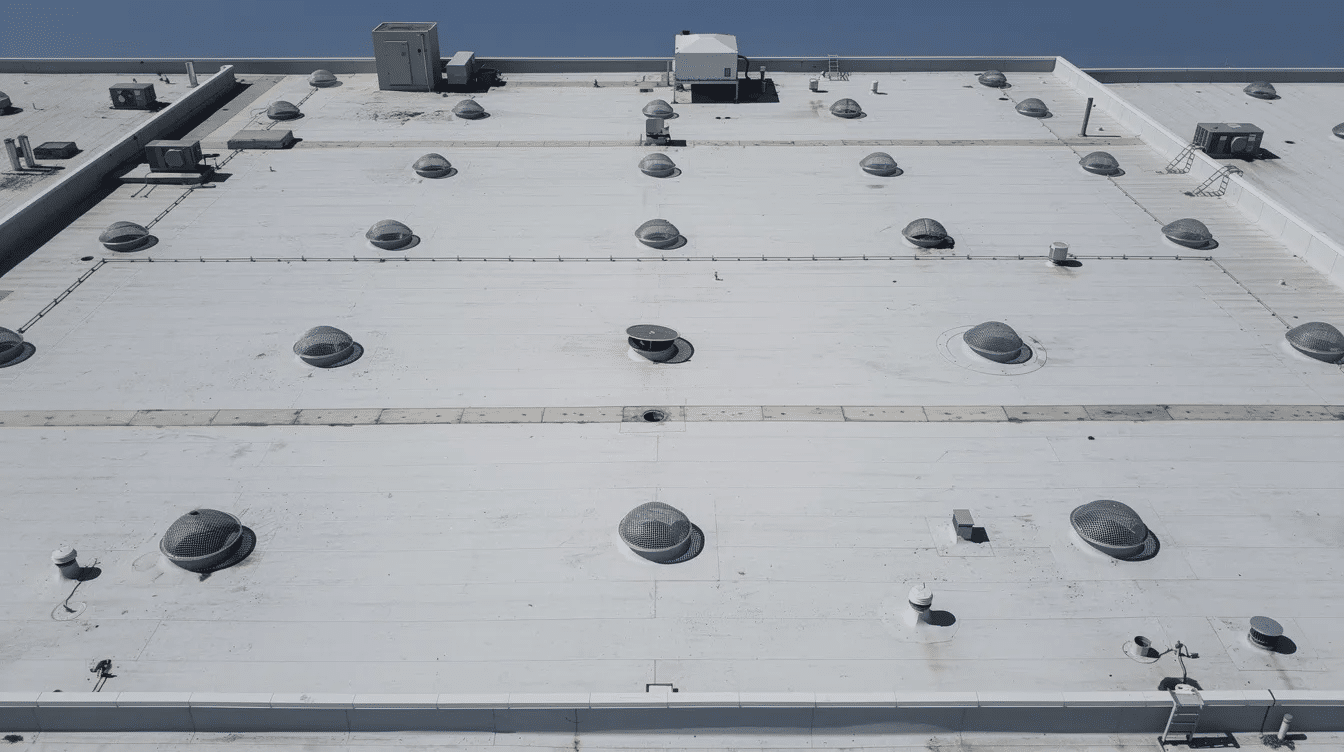
Internal roof drains are the primary drainage method on most large commercial buildings. Primary interior drains are positioned at structural low points to capture runoff. Each drain consists of a bowl or ring embedded in the roof surface, connected to piping inside the building that carries water to the storm system. A domed strainer sits on top to block debris. Internal roof drains need to be properly integrated with roofing membranes at the flange to prevent leaks around the penetration.
Roof scuppers are horizontal openings cut through parapet walls that allow water to exit off the roof edge, typically into a conductor head, gutter, or downspout. Scuppers can serve as primary drainage or as secondary overflow drainage, depending on the roof design. Second drains or scuppers prevent water retention if primary drains become clogged. Many commercial buildings use both interior drains and scuppers on the same roof for layered protection.
Gutters and downspouts collect water at low-slope edges, especially on metal roof assemblies and combination steep/low-slope buildings. Edge metal details direct water into the gutter channel.
Tapered insulation and crickets create slope on otherwise level decks. Tapered polyiso boards are factory-cut at precise angles and laid across the roof deck to direct water toward drain locations, scupper openings, and gutter lines. Crickets are small peaked structures built behind equipment curbs and parapet walls to prevent water from collecting in dead spots.
Flat and low-slope roofs may use interior drains, scuppers, gutters, downspouts, or a combination of these systems depending on the roof design. Gravity drainage systems are suitable for many commercial roofs, but the often-cited guideline of roofs under 150 square meters per drain is not a universal sizing rule. For larger commercial buildings, siphonic drainage systems use full-bore pipe flow and can provide much greater drainage capacity than gravity systems, although claims that siphonic drainage can achieve 100 times the speed of gravity drainage should not be treated as a universal performance standard.
Common Causes of Ponding Water on Commercial Roofs
These are the drainage issues Corpus Christi commercial property owners encounter most often on their roofs.
Improper original design or installation. Some buildings were constructed with dead-level decks and almost no slope, too few drains or scuppers for the roof area, or drains positioned at high points instead of actual low spots. Poor drainage from original design is expensive to correct but impossible to maintain away.
Clogged internal drains and strainers. Debris accumulation can clog internal roof drains, causing drainage failures. Leaves, plastic bottles, roofing debris from previous repairs, and wind-blown trash fill drain bowls and cover dome strainers. In Corpus Christi, a single tropical storm can deposit enough material to block drains across an entire roof.
Blocked scuppers and downspouts. Bird nests, salt-rusted grates, or compacted debris in scupper throats and conductor heads limit water flow during heavy rainfall. Backup drains prevent overflow during heavy rain or clogs, but only if they exist and remain clear.
Compressed insulation. Repeated foot traffic, stored pallets, or equipment staging crushes polyiso boards and creates shallow birdbaths in the roofing system. These low spots trap water even when drains are functioning.
Structural deflection or building settling. Older buildings often have decks that sag between joists. Deck deflection alters the original roof slope over time, creating new low spots that the existing roof drainage layout was never designed to serve. Excessive weight from pooling water can exacerbate structural deflection, creating a cycle where ponding deepens with each storm.
Rooftop equipment changes. Added HVAC units, ductwork, and curb extensions block water paths. When installers don’t adjust nearby positive drainage or add crickets, rooftop equipment creates dams.
Improper recover or coating projects. New layers installed directly over an existing roof with low spots or clogged drainage points trap the ponding problem underneath. Without correcting slope, a recover just moves the leak to a new membrane.
One detail that puts the weight risk in perspective: one inch of water across 1,000 square feet weighs about 5,200 pounds. On a 10,000-square-foot commercial roof with even a half-inch average depth of ponding, water weighs roughly 26,000 pounds.
Drains and Scuppers: How They Fail and What to Look For
Most serious ponding issues on commercial roofs trace back to problems at drains and scuppers. Both serve as water outlets, but they work differently and fail in different ways.
A roof drain sits within the roof surface and connects to internal piping. A scupper is an opening through a parapet wall that lets water drain off the edge externally. Many Corpus Christi commercial buildings use both; interior drains handle primary drainage, and scuppers serve as overflow or secondary outlets.
Common drain problems:
- Missing or damaged strainers that allow debris into the bowl and downstream piping
- Debris-filled drain bowls from leaves, gravel, and trash
- Poorly sealed drain flanges where the membrane meets the drain ring, creating leaks
- Rusted cast-iron or galvanized components weakened by salt air
- Disconnected or bellied internal piping that traps water inside the building
Common scupper problems:
- Undersized openings that cannot handle the flow rate during Corpus Christi storm intensities
- Rusted metal scupper boxes with holes or collapsed sections
- Loose or failing sealant around the scupper-to-wall connection
- Clogged conductor heads and downspouts that back up water onto the roof
What to look for on the roof surface:
- Standing water surrounding drains or scuppers hours after rain stops
- Dark stains or algae rings marking where water collects repeatedly
- Soft or spongy membrane directly around drain assemblies (indicating wet insulation underneath)
- Corrosion streaks visible under scupper outlets on the building’s exterior wall
In Corpus Christi’s coastal climate, galvanized and painted metals around scuppers and drains can corrode faster than comparable components in less salty inland environments. Inspecting drains and scuppers regularly helps maintain proper roof drainage and catch component failures before they cause interior leaks.
Damage Ponding Water Can Cause to Commercial Roofs
Even shallow water standing more than 48 hours accelerates damage on every type of commercial roof, and that damage compounds faster in Corpus Christi’s sun and salt-heavy environment.
TPO and PVC membranes. Standing water can increase stress on roofing membranes and vulnerable roof details. Dirt collects in ponded areas, promoting biological growth around seams and flashing. Over repeated wet-dry cycles, existing membrane weaknesses can worsen, and water lingering past 48 hours keeps laps and penetrations exposed to moisture for longer periods.
Asphalt and modified bitumen roofs. Ponding strips protective granules from the surface, exposes the asphalt binder to UV, and causes blistering and alligatoring. Each cycle of ponding and drying leaves the membrane weaker.
Insulation. When water infiltrates through seams or fastener penetrations in low spots, it saturates polyiso or fiberglass boards. Wet insulation loses its thermal value, adds dead weight to the roof structure, and creates conditions for mold or corrosion on the deck below. Trapped moisture rarely dries on its own once insulation is saturated.
Deck and structure. Prolonged ponding can damage the roof membrane, insulation, and the building structure simultaneously. Metal decks rust at fastener points. Wood decking rots. Ponding can lead to roof material damage and structural issues when accumulated water overloads framing members not designed for sustained hydraulic loads.
Metal roof assemblies. Water trapped behind poorly detailed curbs or backed up at gutters corrodes coated steel and aluminum. Corrosion at panel laps and fastener holes leads to leaks that are difficult to trace.
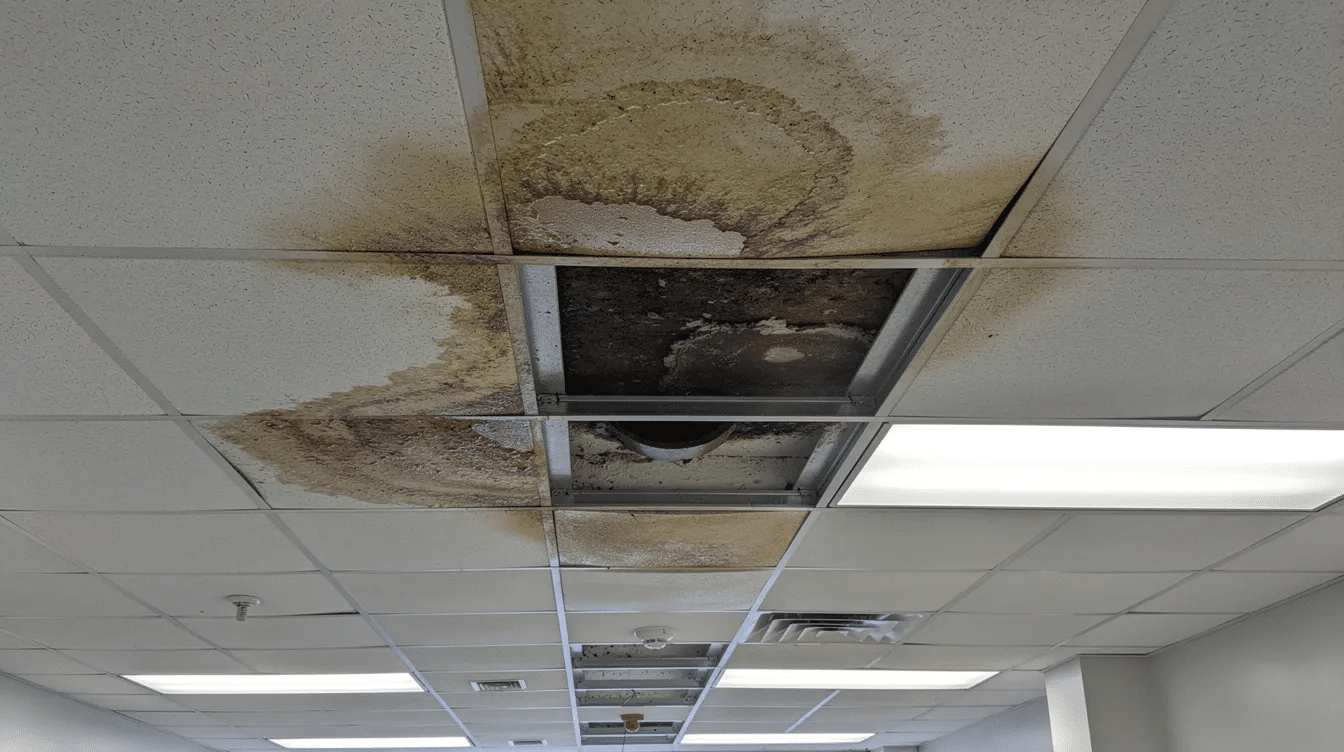
Interior consequences. Ceiling leaks, stained tiles, mold, and electrical hazards in offices, retail spaces, and industrial facilities. In the Commerce Office Park v. TWIA case in Corpus Christi, the dispute included arguments involving ponding, corrosion, wear, maintenance conditions, and storm damage, illustrating how preexisting roof conditions can become part of an insurance dispute.
Diagnosis: Why Is My Commercial Roof Still Holding Water After Drains Are Cleaned?
This is a common complaint from Corpus Christi building owners: the drains were just cleaned, but the same puddles reappear after every storm. If that describes your roof, the problem runs deeper than debris.
Clearing debris from drains and scuppers is only the first step. Routine inspections should address drain locations and their effectiveness in preventing ponding, but long-term ponding typically points to one or more underlying causes.
Low spots caused by compressed insulation or deflected decking physically trap water even when all outlets are clear. If the roof deck sags a quarter inch between supports, that depression will collect water indefinitely regardless of how clean the drain is ten feet away.
Undersized or poorly located drains and scuppers may handle a light shower but cannot keep up with the intense rain rates common in coastal Texas. A roof with only two drains serving 15,000 square feet may still pond during heavy storms if the drains, piping, or overall drainage system are undersized for the roof area and local rainfall intensity.
Rooftop additions, including new HVAC units, solar supports, and parapet modifications, can create dams that redirect water into ponding zones. The drainage layout may need redesign to account for altered flow paths.
Professional evaluation involves more than a roof walk. An experienced contractor will use laser or water-level checks to map actual slope versus designed slope, run moisture scans to locate wet insulation, and inspect internal drain piping and overflow systems that aren’t visible from the surface. Draining solutions must comply with local building codes to manage heavy rain effectively, and Corpus Christi adopted the 2021 International Building Code as of August 2023.
For a broader look at how drainage fits into overall roof system care, property owners should explore commercial roofing services in Corpus Christi, including full inspections and repair planning.
Practical Drainage Solutions for Flat and Low-Slope Roofs
Fixing drainage on a commercial roof is not a DIY project. The roofing system, structural capacity, and code requirements all factor into the right solution. Here is what the options look like.
Maintenance-based solutions: Scheduled cleaning of drains, scuppers, gutters, and strainers resolves debris-related ponding. Replacing rusted strainers, clearing conductor heads, and removing accumulated material after coastal storms are the baseline. Twice-yearly inspections of drainage systems are recommended for maintenance at minimum.
Adding or resizing outlets: When the existing roof has too few drains or undersized scuppers, a contractor can cut new scupper openings, add drain bodies, or upsize existing outlets. Drain locations should be verified against actual low points, not just original drawings.
Slope correction: Installing tapered insulation systems over the existing roof deck restores positive drainage on flat roofs. Localized crickets behind rooftop equipment and along parapet walls direct water toward outlets. Small birdbath areas can sometimes be resurfaced without a full tear off.
Repair vs. replacement: If ponding has already saturated insulation, corroded the deck, or caused widespread membrane failure, patching individual pond spots will not restore the roof. In those cases, replacement planning should include corrected slope, new drainage layout, and code-compliant overflow provisions. Not every roof needs replacement, but some do, and a professional evaluation distinguishes between the two.
Metal roof drainage: Properly designed gutters and downspouts, valley details, and crickets behind large curbs address water accumulation on metal roof assemblies. Coatings can protect pond-prone areas on older metal panels, though coatings alone do not fix slope deficiencies.
Commercial Roof Maintenance for Drains and Scuppers in Corpus Christi
Many serious ponding and leak issues could be avoided through routine commercial roof maintenance focused on drainage. Coastal environments create unique stress factors for commercial roofing systems, and Corpus Christi roofs need more attention than their inland counterparts.
Recommended schedule:
| Timing | Actions |
|---|---|
| Spring (pre-storm season) | Full drain and scupper inspection, clean all outlets, check strainer condition |
| Late summer/fall (peak tropical weather and hurricane season) | Repeat inspection, clear storm debris, assess any new ponding areas |
| After major storms | Walk the roof within a few days, clear blocked drains, photograph standing water |
Key maintenance tasks at each visit:
- Clear debris from drain bowls, dome strainers, and scupper throats
- Clean gutters and downspouts; verify water can flow freely to grade
- Check for compressed insulation and new low spots; mark recurrent ponding areas
- Inspect metal components for corrosion, especially on buildings near the bay
- Look for open seams, blistering, or soft spots around drain assemblies
Document conditions with photos, simple roof maps, and notes. Comparing records year over year reveals whether ponding areas are stable or growing, and whether roofing materials around drains are deteriorating. This documentation also supports insurance claims if storm damage occurs.
Proactive drainage care extends the useful life of TPO, PVC, modified bitumen, coatings, and metal roof systems. A roof that drains properly dries faster, resists biological growth, and avoids the accelerated wear that ponding inflicts. For more detail on how drainage maintenance fits into a complete care program, learn about commercial roof inspections and repairs through Corpus Christi commercial roofing services.
When to Call a Commercial Roofing Professional About Drainage Problems
Building owners and maintenance staff can handle basic debris clearing. Recurring ponding water, active leaks, or visible damage to the roof deck require a roofing professional with commercial experience.
Red-flag situations that warrant a call:
- Water standing more than 48 hours after rain in the same locations
- Repeatedly wet insulation discovered during repairs or maintenance
- Visible rust, rot, or deterioration near drains or scuppers
- Any sagging or soft spots in the roof surface
- Interior water damage that aligns with known ponding areas above
Adding drains, reworking scuppers, or installing tapered insulation requires knowledge of roof structure, plumbing connections, and manufacturer specifications. A qualified contractor evaluates the full roof assembly: membrane, insulation, deck, drains, scuppers, and rooftop equipment. Patching visible cracks around a ponding area without addressing the cause wastes money.
Building codes and warranty implications matter. Some roofing manufacturers limit coverage on roofs with chronic ponding, and the IBC requires positive drainage when major reroofing work is performed. Ignoring these requirements can void warranties and create code violations.
During a professional drainage evaluation, commercial property owners in Corpus Christi can expect:
- An on-roof inspection covering all roof sections, drains, scuppers, and edge conditions
- Moisture detection scans to locate wet insulation beneath the membrane
- Review of leak history and previous repairs
- A written plan that may range from maintenance adjustments to localized repair to broader replacement planning
Ja-Mar Roofing & Sheet Metal is a long-serving Texas roofing contractor with direct experience in Corpus Christi’s coastal conditions. They offer drainage-focused inspections and can evaluate whether a commercial building needs maintenance, repair, or a more involved drainage correction. Their familiarity with local building codes, roofing materials, and the specific demands of salt air and heavy rainfall environments means the evaluation accounts for factors that generic assessments often miss.
FAQs About Commercial Roof Drainage, Ponding Water, Drains, and Scuppers
These questions address specific drainage and ponding concerns that may not have been fully covered in the sections above.
Is ponding water normal on a commercial roof?
Brief, shallow puddles immediately after a storm can occur on any low slope roof. But ponding water is defined as standing water after 48 hours, and that is not normal. Building codes and manufacturer guidelines for low-slope commercial roofs expect positive drainage. If water remains in the same spot two days after a storm, the drainage system has a problem that needs investigation.
How long can water sit on a flat roof before it becomes a problem?
The 48-hour threshold is the standard used by most roofing manufacturers, insurance inspectors, and the NRCA to classify standing water as ponding. In Corpus Christi, damage can begin sooner. UV intensity and heat amplify the effect of standing water on membranes and coatings, and humid conditions slow natural evaporation that might bail out a roof in a drier climate.
What is the difference between a roof drain and a scupper?
A roof drain is an internal drain set into the roof surface, connected to piping inside the building that carries water to the storm system below. A scupper is an opening through a parapet wall or roof edge that lets water exit externally, often into a conductor head, gutter, or downspout. Many commercial buildings use roof drains as primary drainage and scuppers as emergency or overflow drainage in case the drains or piping back up.
Can ponding water damage TPO or PVC roofing membranes?
Yes. Prolonged ponding increases the risk of accelerated surface wear, dirt accumulation, biological growth, and stress at seams and flashing details on TPO and PVC systems. While single-ply membranes are waterproof, they are not designed to serve as long-term water basins. Chronic ponding can affect manufacturer warranties and shorten the service life of the membrane.
How often should commercial roof drains and scuppers be inspected in Corpus Christi?
At least twice per year: once in spring before hurricane season and once ahead of peak late-summer and fall tropical weather. Additional checks after any major storm are standard practice. Buildings near the bay, ship channel, or barrier islands may need more frequent inspections because of faster corrosion from salt air and heavier debris loads from sustained wind exposure.

