
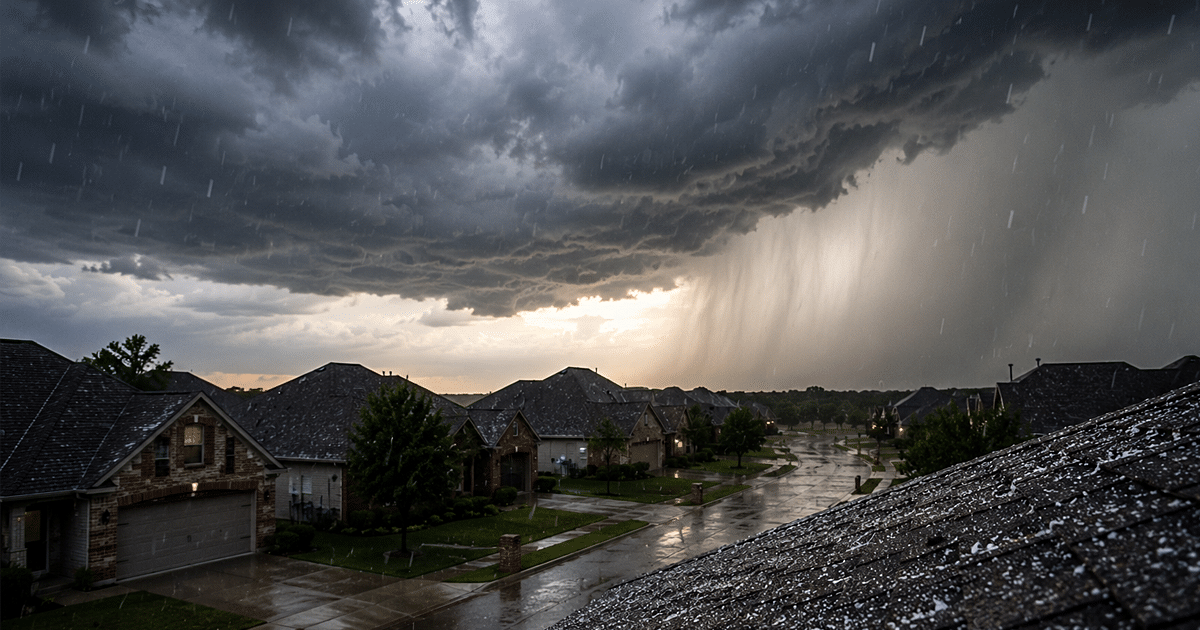
The hail hasn’t even stopped bouncing off the pavement before your phone starts ringing. By the time you walk outside to check your roof, there’s already a truck parked at the end of your driveway with a magnetic sign on the door and a stranger walking toward you with a clipboard. This is the reality for homeowners across Texas after any significant hail event — and if you live in DFW, Austin, San Antonio, or anywhere along the I-35 corridor, you’ve probably seen it firsthand.
Storm chasers roofing is a term that gets thrown around a lot in the industry, but most Texas homeowners don’t fully understand what it means, how the post-storm roofing rush actually works, or what decisions made in the first 48 hours can cost them years down the road. This guide walks you through everything — from your immediate steps after hail damage to filing your insurance claim, vetting contractors, and protecting yourself from the tactics that follow every major hail event in the Lone Star State.
Right up front, here’s the straightforward answer most homeowners need:
What should Texas homeowners do immediately after hail damage?
Focus on family safety first, document all exterior damage from the ground, save weather reports tied to the storm date, contact your insurance company promptly, schedule a professional inspection with a vetted local roofer, and avoid signing any contracts until you fully understand your roof’s condition and your insurance coverage.
Key Takeaways
- Texas gets more hailstorms than any other state, and roof damage often starts before leaks ever appear
- Never climb onto the roof after a storm. Document damage safely from the ground with photos and video
- Storm chaser roofing companies flood Texas neighborhoods after major hail events, so contractor vetting matters
- Filing your insurance claim early and keeping detailed records can help avoid delays and coverage disputes
- Dented gutters, granule buildup, bruised shingles, and soft metal impacts are some of the first visible signs of hail damage
- A trusted local roofer can help identify hidden storm damage that insurance adjusters may overlook during initial inspections
Immediate Steps After Hail Damage
When a serious storm rolls through — quarter-sized hail, golf ball sized hail, strong straight-line winds — the instinct is to get outside and start assessing. That’s understandable. But the first priority after any major hail event isn’t your roof. It’s your family.
Ensure everyone is away from damaged areas before you do anything else. Hail storms in North Texas and Central Texas frequently produce structural damage, broken glass, and downed tree limbs that create immediate hazards at ground level. Once it’s safe, move through this sequence:
- Ensure family safety and move away from damaged areas before going outside
- Photograph all exterior damage from the ground with date-stamped photos and video
- Save weather reports and official hail measurements tied to the storm date
- Avoid climbing on the roof — leave the roof surface to a licensed professional inspection
Most damage observed right after a storm is only what’s immediately visible. What many homeowners miss is how hail impacts affect the underlying mat of asphalt shingles. Even when the surface looks intact, the structural integrity of the roof can already be compromised. Texas is the most hail-prone state in the country, experiencing over 400 hailstorms annually — and a serious texas hailstorm can produce both hail damage and wind damage in a single pass, sometimes compromising roof areas that look untouched from the ground. In major hail events across hail alley regions, insurance adjusters rely heavily on early documentation. Photos, timestamps, and weather data all contribute to how your insurance claim is evaluated. Keep a clear record tied to the specific storm date — get that documentation locked in before anything else.
Quick Ground-Level Checks for Asphalt Shingles
You don’t need to get on the roof to gather useful information. A methodical walk around your home after a hail event can tell you a lot about the likely scope of damage — and give you something concrete to discuss with your insurer and contractor. Work through these checks before calling anyone:
- Inspect gutters and downspouts for granule buildup — heavy granule loss is one of the most obvious signs of hail impact on asphalt shingles
- Scan for dented vents and metal flashings — soft metals like aluminum gutters and HVAC covers dent easily and document the storm’s intensity
- Use binoculars to check ridge caps — bruising, splitting, or missing ridge cap material from the ground is worth flagging for your inspector
- Note discoloration or missing shingle tabs — irregular surface texture or dark circular patches often indicate hidden damage beneath the surface
- Check for soft spots along the roofline edges and around penetrations where hail impacts concentrate
- Trim overhanging branches after the storm — debris sitting on the roof surface holds moisture and accelerates deterioration of already-compromised shingles
Protective granules are embedded in the shingle surface to shield the underlying mat from UV exposure and weathering. When hail impacts knock them loose in volume, the exposed asphalt layer deteriorates faster — especially under Texas heat. Hailstones larger than one inch in diameter can cause significant bruising and granule loss on asphalt shingles, accelerating aging even when no leak is immediately visible. If your gutters are showing dents consistent with golf ball sized hail, your roof almost certainly absorbed the same impact. Document all of it before the first contractor arrives.
Temporary Repairs While You Wait for Help
After a major hail event in Texas, reputable local roofing contractors get busy fast. Lead times for a full professional inspection can stretch to several days, and replacement scheduling during active hail season can extend further. In the meantime, protecting your home from additional water infiltration is a legitimate priority.
- Place buckets under active leaks and move belongings away from affected areas
- Cover exposed attic vents with plastic sheeting as short-term containment
- Call a local emergency roofer in Austin for emergency tarping — don’t attempt to tarp the roof yourself
- Avoid DIY roof tarping on steep or wet roofs — injury risk is real and an improperly installed tarp can complicate your insurance claim
If attic spaces begin showing moisture or stains, that’s a strong sign hidden leaks are already forming. Roofing cement or plastic sheeting may slow water infiltration as a stopgap, but they don’t restore the roof’s condition or count as a repair for insurance purposes. Emergency tarping performed by a licensed contractor with storm damage roof repair expertise is typically a reimbursable expense under your homeowner’s insurance policy and creates a documented chain of custody for your claim — which is far better than an amateur tarp job that gives your adjuster room to question the original damage scope.
Filing an Insurance Claim After Hail Damage
This is where timing and documentation matter most. Contact your insurance company promptly after a storm event. In Texas, homeowners generally have up to one year from the date of loss to file a hail damage claim — though your specific policy terms control this, and waiting longer than necessary gives insurers more room to question the origin of the damage.
- Contact your insurance company promptly and provide the date of loss and basic damage description
- Upload date-stamped photos to your claim portal as soon as possible
- Request an adjuster visit and keep the appointment
- Record your claim number and reference it in every subsequent communication
The initial claim filing sets the tone. Clear documentation tied to a specific storm date improves your chances of proper insurance coverage and speeds the adjuster process. While Texas law allows up to one year to file, most professionals recommend filing within 30 days of the storm to keep the process moving and your documentation fresh. One critical rule before you file: do not sign any repair contracts before notifying your insurer. Some contractors — particularly those operating in the storm chasing model — will push homeowners to sign agreements before a claim is even opened. This can create complications with your insurance coverage and in some cases trigger assignment-of-benefits clauses that transfer control of your claim to the contractor. Open your claim first. Every time.
Working With the Insurance Company and Adjuster
The adjuster inspection is where your claim gets shaped, and it’s worth treating it seriously. This step can make or break your outcome.
- Notify your insurer before signing any repair contracts
- Attend the adjuster inspection with your roofer present if at all possible
- Compare the adjuster estimate to the contractor estimate line by line
- Submit supplemental documentation when items are missing from the adjuster’s scope
Insurance adjusters evaluate based on visible indicators and policy limits. The challenge is that not all hail damage is immediately visible. Bruising beneath shingles, compromised seal strips, soft spots in the roof deck, and damage to the underlying mat often require a trained eye to identify during the inspection. Having a contractor present helps ensure nothing gets missed — and when the adjuster’s estimate comes back short, your contractor can submit supplemental documentation with photos, measurements, and material specifications to support an amended claim. This is a normal and legitimate part of the insurance process, not an adversarial act.
Avoiding Low-Ball Offers and Insurance Fraud
After major hail events, this becomes a real issue across DFW, Central Texas, and San Antonio. The post-storm roofing rush brings legitimate contractors and bad actors into the same neighborhoods simultaneously, and knowing the difference matters.
- Refuse upfront assignment-of-benefits requests — signing over your insurance rights removes you from the process
- Decline on-the-spot full-payment demands or requests for large upfront deposits before work begins
- Verify contractor licensing through TDLR and confirm a local physical address — not a P.O. box or hotel room
- Ask for a written scope and itemized estimate before engaging further
If someone offers to waive your deductible or wants full payment immediately, that’s a red flag worth acting on. Waiving an insurance deductible is illegal in Texas under the Insurance Code. A contractor who offers it is either planning to inflate the claim to cover the difference or cut corners on materials and labor to make the math work — and the liability for a fraudulent claim doesn’t stay with the contractor. It follows you as the policyholder. Report any such offer to your insurer directly.
How to Vet Estimates to Avoid Low-Ball Offers
Not all estimates are created equal, and a number that looks attractive on paper often reflects real tradeoffs you won’t discover until something fails. When you’re fielding multiple bids after a storm, here’s how to compare them properly:
- Request at least two estimates from local residential roofing specialists with established presence in your market
- Compare line-item pricing for materials and labor — not just the bottom line
- Check warranty details for both shingles and workmanship before assuming coverage is comparable
- Ask for references from nearby, recent jobs in your specific Texas market
A below-market estimate usually reflects cuts somewhere you can’t see — lower-grade underlayment, skipped decking inspection, inadequate flashing replacement, or reduced nail pattern compliance. These aren’t visible in the finished product, but they determine how your roof performs over the next 15 to 25 years. A vague estimate with a single bottom-line number is not a sufficient basis for a roofing contract. Clear, itemized scopes protect you from unexpected costs and incomplete work — and they’re what every legitimate contractor should be able to provide without hesitation.
Choosing a Local Roofer in Central Texas and Beyond
This decision carries long-term consequences. Storm chasers come and go. A true local roofer understands texas building codes, local permit requirements, and climate patterns in ways that a contractor who arrived three days after your storm simply doesn’t. One fact most Texas homeowners don’t know: Texas does not require a statewide roofing license, which means the barrier to entry is low and the industry is prone to out-of-state operators setting up shop after major hail events. That makes verifying credentials and local presence even more important — not less.
- Confirm the contractor has local Google reviews with verifiable history and a permanent office
- Verify insurance and roofing-specific licenses — ask for a certificate of insurance and call the carrier to confirm it’s active
- Request a written inspection report with photos documenting pre-work roof condition
- Prioritize companies with demonstrated experience serving Austin, Dallas-Fort Worth, San Antonio, Corpus Christi, and surrounding communities
Local contractors offering trusted Austin roof repair services have a fundamentally different relationship with their market than storm chasers do. Their reputation is built street by street, neighborhood by neighborhood, over years — not weeks. A bad job doesn’t just hurt one customer. It ripples through the community in ways that directly affect their ability to work next year and the year after. That accountability changes how they operate at every level — materials, crew oversight, process, and follow-through after the job is done. To make informed decisions, know your rights: in Texas, homeowners have three business days to cancel a roofing contract in writing after signing, provided work has not yet started. Use that window if you feel pressured into something before you were ready.
Companies like Ja-Mar Roofing & Sheet Metal have built their reputation over decades, not just one storm cycle. As a GAF Master Elite certified contractor — a designation held by fewer than 3% of roofers in the country — Ja-Mar installs roofing systems backed by manufacturer warranty coverage that remains in force long after the storm chasers have moved on to the next market. That stability matters when protecting your most valuable investment.
Understanding Asphalt Shingles and Visible Hail Signs
Hail damage goes deeper than surface marks. Asphalt shingles are the most common roofing material on residential homes across Texas, though metal roofing is increasingly common in both residential and commercial applications. Regardless of material, a professional post-storm inspection is the only way to document the full scope of damage — what’s obvious signs from the ground rarely tells the complete story of your roof’s condition.
- Identify granule loss on shingle surfaces — concentrated dark circular patches indicate point-of-impact damage where protective granules have been displaced
- Look for bruising and split shingle tabs — soft depressions in the shingle surface indicate the underlying mat has been compressed or fractured
- Inspect gutters for excess shingle granule runoff — heavy granule accumulation after a storm is accessible evidence without getting on the roof
- Document dents on aluminum gutters and HVAC units — soft-metal impacts are objective evidence of hail size and intensity
Protective granules shield the underlying mat from UV exposure and moisture. When those granules are lost, the asphalt layer beneath deteriorates faster — and in Texas climates, that deterioration speeds up significantly due to heat cycles and constant sun exposure. Hidden damage that isn’t caught during the post-storm inspection becomes a hidden leak source within one to two hail seasons, and by then the roof’s condition has deteriorated well beyond what the original storm caused. Document everything you can observe and let a credentialed local roofer assess what you can’t.
When Repair Is Enough Versus Full Replacement
This is one of the biggest decisions homeowners face after a hail event, and it’s worth getting right. Not every storm produces damage that warrants a full roof replacement — and being pushed into unnecessary work is just as costly as missing damage that needed to be addressed.
- Evaluate roof age against damage severity — an older roof with widespread impact damage is typically a replacement candidate
- List localized damage eligible for repair — confined damage without widespread granule loss or structural compromise may qualify
- Request a new roof estimate when damage is widespread across multiple slopes or the roof deck is compromised
- Confirm full replacement scope in writing before signing — shingle product, underlayment, decking inspection, flashing, disposal, and permit should all be documented
Insurance adjusters often consider how much of the roof surface is affected. At a certain threshold of widespread hail impacts — missing shingles across multiple slopes, significant damage to ridge caps, dented gutters combined with visible storm damage to field shingles — repairs become temporary fixes rather than real solutions. When storm damage is that widespread, full roof replacement is typically the more practical and cost-effective path. Your contractor should be able to walk you through the logic clearly and provide written documentation supporting whichever recommendation they’re making. Be cautious of any contractor who pushes immediately for full replacement without a thorough inspection — and equally cautious of one who minimizes obvious widespread damage to reduce the scope of work.
New Roof Planning and Full Replacement Tips
If replacement is on the table, a hail event is actually an opportunity to make a smarter long-term investment — especially in Texas, where hail season isn’t a one-time event but an annual reality across hail alley.
- Select impact-rated materials if available — Class 3 or Class 4 impact resistant shingles are engineered to withstand hail impacts that damage standard asphalt shingles
- Request manufacturer warranty transfer details before the job starts — a transferable warranty adds real value at resale
- Schedule replacement before peak hail season where possible — active hail months in Texas typically run March through June
- Confirm disposal and permit responsibilities in writing — both should be the contractor’s obligation, not yours to manage
Impact resistant roofing materials cost more upfront, but they often reduce long-term repairs and can help with insurance premiums. Many Texas insurance carriers offer discounts for Class 4 rated shingles — ask your contractor for a side-by-side comparison and check with your insurer about available discounts before making the final material decision.
Insurance Claims Strategy During Hail Season
Texas hail season isn’t a single event — it’s a sustained window of risk that can produce multiple claim-worthy storms in a single year. Managing your insurance relationship through that window strategically matters.
- File claims early in the season after storm events — don’t wait and risk complications if additional storms pass through
- Keep records of all communications with your insurer, including dates, times, and representative names
- Escalate disputed claims with supplemental estimates when the adjuster’s scope is incomplete
- Consider a public adjuster only after careful vetting — verify their Texas Department of Insurance license and understand their fee structure before signing
Filing early ties your claim directly to a specific hail event. Waiting too long can create complications if additional storms move through and the damage origin becomes disputed. When the adjuster’s estimate comes back short, supplemental documentation submitted through the proper channels is the right path — not a pressure campaign or inflated claim. Keep the process clean and documented from the first call to the final payment.
Signs of Potential Insurance Fraud to Watch For
Insurance fraud in the post-storm roofing market is a real problem in Texas, and it doesn’t always look like an obvious scam. Sometimes it looks like a friendly contractor who knows exactly what to say after a stressful storm.
- Beware contractors offering to waive your deductible — it’s illegal in Texas and signals a fraudulent or cut-corners operation
- Avoid high-pressure immediate-signing tactics of any kind — legitimate contractors don’t manufacture urgency
- Flag unusually low estimates with vague scopes — a price significantly below comparable bids almost always reflects real tradeoffs in materials, labor, or warranty
- Report suspicious practices to your insurer and the Texas Department of Insurance
If it feels rushed or too easy, step back. The contractor who wants your signature today and is willing to waive your out-of-pocket costs isn’t offering you a deal — they’re creating conditions where corners get cut in ways you won’t see until your roof fails. That failure lands on you, not them. By then, they’re working the next storm market in another state.
Post-Claim Steps and Long-Term Maintenance
Once your roof is repaired or replaced, the insurance process ends — but the maintenance relationship that keeps your investment performing for the next 20 to 30 years is just beginning.
- Schedule annual roof inspections after replacement, particularly approaching the mid-point of the warranty period
- Remove debris and clear gutters and downspouts regularly, especially after storms
- Keep a file of photos, warranty documents, permit records, and contractor information
- Monitor attic spaces for new moisture or stains after rain events — early detection prevents expensive interior damage
Routine maintenance catches minor issues before they turn into expensive problems. A flashlight inspection of your attic after heavy rain — looking for wet insulation, water stains on the roof deck, or daylight through the decking — is a simple habit that protects your investment between professional inspections. When you sell the home, your documentation file demonstrates the quality and provenance of the roof installation and supports any warranty transfer.
Sample Emergency Checklist for Texas Homeowners
When a hail storm hits, it’s easy to feel overwhelmed. Having a clear sequence to follow cuts through the noise and makes sure nothing important gets missed in the first 24 to 72 hours.
- Collect roof photos and video evidence from the ground immediately after the storm
- Document soft-metal impact evidence — gutters, downspouts, HVAC units — with date-stamped photos
- Save weather reports and official hail measurements from the storm date
- Call your insurance company to open a claim and record the claim number
- Contact a vetted local roofer for a professional post-storm roof inspection
- Secure temporary covers for active leaks through a licensed contractor — not DIY
- Schedule and attend the adjuster visit with your roofer present
- Compare the adjuster estimate to your contractor’s estimate before signing anything
- Verify contractor licensing, insurance, and local address before committing
- Do not sign over assignment of benefits or agree to deductible waivers
Next Steps for Homeowners Concerned About Hail Damage
If a recent storm has left you wondering about your roof’s condition, the path forward is straightforward — even if it doesn’t always feel that way when your inbox is full of contractor solicitations and your neighbor is telling you to just go with whoever knocked on their door first.
- Prioritize safety, documentation, and local expertise in that order
- Avoid signing over your insurance rights to any contractor
- Get multiple qualified estimates before committing — compare scope, not just price
- Act before Texas heat accelerates roof deterioration — what looks minor now can turn into hidden leaks and structural issues by midsummer
Once the storm passes, the Texas heat kicks in. Elevated temperatures accelerate granule loss from already-damaged shingles, dry out exposed underlayment, and expand any cracks or gaps in flashing and sealants. A damaged roof that might have held through spring becomes a genuine problem by July. Don’t let a contractor’s backlog or your own schedule push the work past the point where the roof’s condition deteriorates further.
Ja-Mar Roofing & Sheet Metal has served Texas homeowners since 1970 — through more hail seasons than most contractors in our markets have been in business. As a GAF President’s Club and Master Elite certified contractor, we hold a designation held by fewer than 3% of roofers in the country, and we back every job with warranty coverage that’s still in force long after the storm chasers have moved on. If you’re dealing with hail damage in DFW, Austin, San Antonio, Corpus Christi, or the surrounding areas, reach out to us before you sign anything. A second opinion costs you nothing and could save you considerably more.
Common Questions About Hail and Roofing in Texas
Which state gets the worst hail?
Texas consistently ranks as the most hail-prone state in the country. The state experiences over 400 hailstorms annually, and the corridor running through North Texas and Central Texas — commonly called hail alley — sits at the intersection of warm Gulf moisture and cold fronts from the north that produce the severe storm conditions driving major hail events year after year. Texas homeowners face more frequent and more severe hail damage risk than virtually anywhere else in the US.
What is the strongest roof against hail?
Class 4 impact resistant roofing materials — tested under UL 2218 standards — offer the highest level of hail resistance available for residential roofing. Metal roofing also performs well against hail impacts, though large hail can still cause denting on softer metal panels. Among asphalt shingles, architectural shingles provide significantly better durability than traditional 3-tab shingles. For Texas homeowners in hail alley regions, Class 4 impact resistant shingles represent the best balance of performance, insurance savings, and long-term value.
Does putting blankets on your car help with hail?
Blankets and moving pads can reduce minor cosmetic damage from smaller hail, but they offer little to no protection against golf ball sized hail or larger. The same principle applies to temporary measures on your roof — roofing cement and plastic sheeting may slow water infiltration after a texas hailstorm, but they don’t prevent storm damage and shouldn’t delay scheduling a professional post-storm inspection. Get your vehicle to covered parking and call your roofer and insurer promptly.
What are the most common signs of hail damage on a roof?
Granule loss on shingle surfaces, dented gutters and HVAC units, bruising or split shingle tabs, and missing shingles are the most common warning signs after a texas hailstorm. Some storm damage is immediately visible; other issues — particularly bruising of the underlying mat — develop into active leaks over one to two hail seasons as moist air and UV exposure work through the compromised areas. A professional post-storm inspection is the only reliable way to document both obvious and hidden damage before those active leaks become a ceiling problem.
What is a storm chaser roofer?
A storm chaser is a roofing contractor — often from out of state — who follows major hail events into a market, canvasses neighborhoods door-to-door, and signs as many jobs as possible before moving to the next storm market. Their business model prioritizes volume over quality, and they’re typically gone within 60 to 90 days — long before most warranty issues surface. They are not invested in your community, and any warranty they issue is only as good as their continued presence in your market.
Can hail damage affect the roof deck?
Yes. Severe hail impacts can compromise the roof deck, especially when moisture begins to penetrate through damaged or missing shingles. Soft spots in the decking — areas where the wood has absorbed water and begun to deteriorate — are a common finding during professional inspections after significant hail events. Once moist air reaches the roof deck and attic spaces, deterioration accelerates quickly under Texas heat. Decking damage that isn’t addressed during a replacement or repair will continue to worsen and eventually require more extensive structural work.
Is it illegal for roofers to waive my deductible in Texas?
Yes, and it’s more serious than most homeowners realize — it’s a felony under Texas law. A contractor who offers to absorb your deductible is setting up either an inflated insurance claim or a cut-corners installation to make the math work. Either outcome creates potential liability for you as the homeowner. Report any such offer to your insurance company and to the Texas Department of Insurance.
What does GAF Master Elite certification mean for a homeowner?
GAF Master Elite is a manufacturer certification requiring a quality audit, verified insurance, and ongoing installation training. It’s held by fewer than 3% of roofing contractors nationally. Practically, it means the contractor can offer Golden Pledge warranty coverage — GAF’s strongest warranty tier — which covers both materials and workmanship and is backed by GAF itself, not just the installing contractor. If the contractor closes their business, your warranty remains intact through GAF.
When is repair enough versus full roof replacement after hail damage?
The two primary factors are roof age and damage severity. An older roof with widespread granule loss, bruising across multiple slopes, and compromised ridge caps is typically a full replacement candidate. A newer roof with localized damage confined to one area may qualify for repair. Your contractor should provide written documentation — with photos from the post-storm inspection — supporting whichever recommendation they make. Be cautious of any contractor who recommends full roof replacement without a thorough inspection to back it up.
Are impact-resistant shingles worth it in Texas?
In most cases, yes. Class 3 or Class 4 impact resistant shingles are engineered to withstand hail impacts that damage standard asphalt shingles. In Texas, where hail season is a recurring annual reality across hail alley, the upgrade makes practical sense. Many Texas insurance carriers offer premium discounts for Class 4 impact resistant roofing materials, which can offset the cost differential over time. Ask your contractor for a side-by-side comparison and check with your insurer before making the final decision.
Why do some roofs fail months after a hailstorm?
Hidden damage. The initial hail impact weakens the shingle’s underlying mat, displaces protective granules, and in some cases compromises the seal strip between shingles without producing an immediately obvious leak. Over time, Texas heat cycles, UV exposure, and moist air work through the compromised areas and produce active leaks that weren’t visible right after the storm. Regular maintenance and annual professional inspections catch these issues before they become significant roof damage — which is exactly why scheduling a post-storm inspection promptly after a texas hailstorm matters even when the roof looks fine from the ground. The adjuster’s visit is not a substitute for a contractor’s detailed inspection.

