
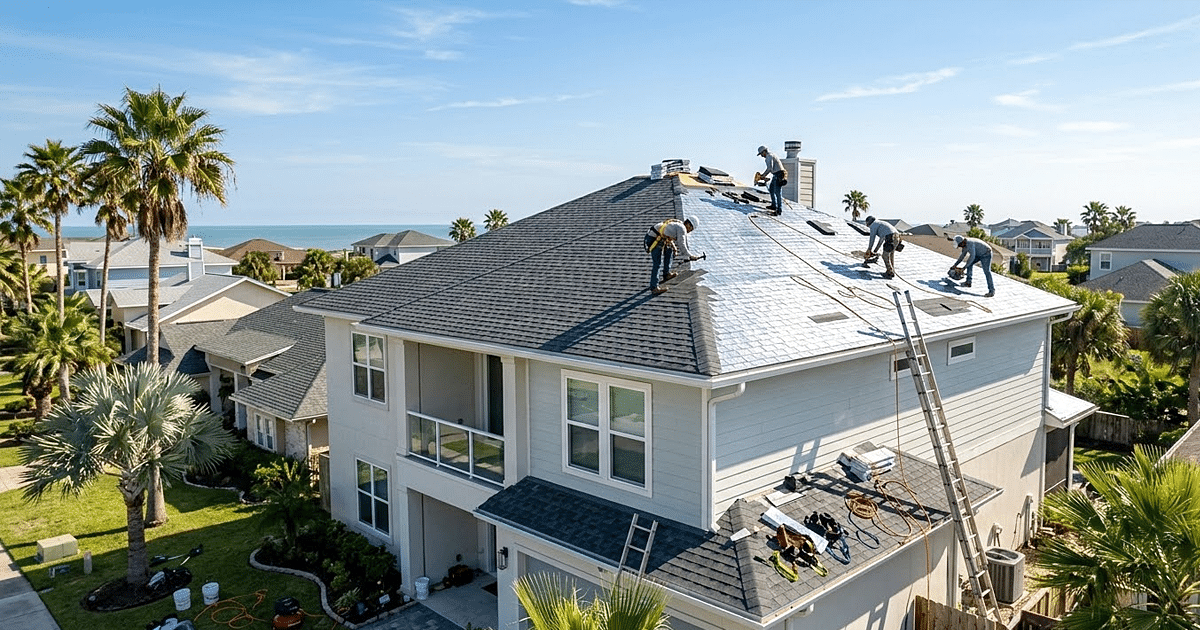
If you own a home on the Texas Gulf Coast, you already know what your roof is up against. Salt air creeps into exposed metal, hurricane season brings sustained wind loads that inland cities never see, and the summer heat in Corpus Christi is relentless. All of that adds up when it’s time to talk about roof replacement costs in Corpus Christi, Texas heading into 2026.
This is not a generic cost guide recycled from a national database. Coastal roofing in South Texas operates under a different set of rules. Roofing material choices that work fine in Dallas can fail prematurely in a salt-air environment. Standard asphalt that holds up in Austin may not survive a Category 2 landfall with 100-mph gusts. Understanding what local conditions mean for your roof replacement cost is the starting point for making a smart decision.
Whether you’re dealing with wind damage from the last named storm, visible deterioration on an old roof that has simply reached the end of its service life, or you’re planning a proactive upgrade before hurricane season, this guide gives you real numbers and a clear breakdown of what drives them. We’ll cover average cost ranges, key factors that affect pricing, material-by-material comparisons, local permitting, contractor selection, and strategies to manage your investment.
Key Takeaways
- Corpus Christi homeowners should budget $8,000–$28,000 for a full roof replacement in 2026, depending on roof size and material.
- Coastal premiums add 10–20% above standard Texas pricing for wind-rated and salt-air-resistant systems.
- Metal roofs and impact-rated architectural shingles are the top-performing options in Corpus Christi’s coastal climate.
- Labor costs account for 35–55% of total roof replacement cost, with higher rates for hurricane-rated installations.
- Off-season scheduling (October–February) can reduce labor costs and improve crew availability.
2026 Roof Replacement Cost Overview for Corpus Christi
A typical full roof replacement in Corpus Christi ranges from $8,000 to $28,000 in 2026. That range is wide by design, because the variables here are substantial. A straightforward 1,500 sq ft home with a moderate pitch and standard architectural shingles lands near the lower end. A larger home with a steep roof, clay tile, and hurricane-rated underlayment lands much higher.
The average roofing cost per square foot in the Corpus Christi market commonly runs between $4.50 and $10.50 for most residential roof replacement projects. That per square foot figure covers materials, labor, tear-off, and standard overhead. It does not include decking repairs, flashing upgrades, or permit fees, which are itemized separately by most contractors.
Compared to statewide averages, Corpus Christi typically runs 10–20% higher due to coastal exposure requirements. Nationally, average roof replacement costs fall between $4.00 and $8.00 per square foot installed for standard asphalt systems. Corpus Christi’s coastal premium reflects the stronger underlayments, wind-rated fastening patterns, and corrosion-resistant materials that local building codes and insurance carriers increasingly require.
Key Factors That Drive Roof Replacement Cost
No single number defines what your roof replacement will cost. Multiple variables interact, and Corpus Christi adds a few coastal-specific ones on top of the standard list. Here are the key factors that determine where your project lands.
Roof Pitch and Complexity
Roof pitch is one of the most immediate pricing variables. Steeper steep roofs require fall-protection harnesses, slower installation pacing, and additional crew members for safety. In practical terms, a roof with a pitch of 8/12 or higher typically adds 20–30% to labor costs compared to a low-slope or walkable surface. Beyond roof pitch, roof design complexity matters. Multiple hips, valleys, dormers, skylights, and chimneys all require custom flashing and trim work that increases both material quantities and installation time.
Roofing Material Choice
Your roofing material selection is the single biggest driver of upfront cost. Asphalt shingles sit at the accessible end of the pricing range. Metal roofs, clay and concrete tile, and single-ply membrane systems each carry different price points, lifespans, and suitability profiles for coastal conditions. We cover each material in detail in the next section.
Permitting, Inspections, and Local Code Requirements
Corpus Christi roofing projects require permits, and local building codes have tightened following recent storm seasons. Wind-rated installation methods, specific fastener patterns, and underlayment requirements are not optional for permitted work. These code requirements add predictable fees and some labor time to every project, but they also protect against future insurance claim disputes.
Contractor Labor Costs
Contractor pricing varies by experience, crew size, certifications, and how busy the local market is. Labor costs in Corpus Christi can spike after major storm events when roofing demand from insurance claims floods the market. During calmer seasons, competition among licensed crews helps moderate pricing. Storm-chaser contractors from out of state often appear after hurricanes; they typically lack local relationships, may not pull permits correctly, and offer weaker workmanship warranties.
Roofing Square, Roof Size, and Per Square Foot Pricing
In the roofing industry, bids are built around a unit called the roofing square—a standard measure covering 100 square feet of actual roof surface. To estimate your project, divide your home’s total roof area in square feet by 100 to arrive at the number of roofing squares. Multiply that count by the per-square replacement cost for your chosen material and you have a working baseline before tear-off, permits, and contingency are added.
A 2,000 sq ft home typically has a roof surface area between 2,200 and 2,600 square feet once pitch is factored in—roughly 22–26 roofing squares. Larger roofs often see slightly lower per-square labor rates because crew mobilization costs spread across more squares, but the total replacement costs still rise proportionally with size.
Per square pricing in Corpus Christi for a standard architectural shingle roof replacement typically falls between $500 and $850 per roofing square installed, including tear-off and underlayment. Metal roofing systems run $800–$1,400 per square depending on the panel type and gauge. Premium tile systems can reach $1,000–$2,000 per square or higher.
Roof Pitch, Design Complexity, and Installation Difficulty
Pitch is measured as rise over run. A 4/12 pitch rises 4 inches for every 12 horizontal inches—considered moderate and walkable. A 7/12 pitch begins to require safety systems. Anything above 8/12 qualifies as steep in most contractor pricing schedules, and steep roofs add significant labor costs across any roofing project.
Beyond the main roof pitch, roof design features like multiple hips and valleys, dormers, and skylights all add material and labor. Each transition requires custom flashing, careful sealing against wind-driven rain, and more precise cuts. In Corpus Christi’s storm environment, any flashing joint that isn’t installed perfectly becomes a liability. Contractors price this complexity accordingly.
Flat and low-slope roofs, common on commercial properties and some residential additions, require an entirely different approach. TPO, EPDM, and modified bitumen membrane systems replace shingles on these surfaces. Drainage design, seam welding or bonding methods, and the membrane’s reflectivity all factor into the final cost differently than a sloped roof installation.
Cost Breakdown by Common Roofing Materials
Material choice shapes both the upfront cost and the long-term value of your roof replacement. In Corpus Christi, coastal durability is the lens through which every material should be evaluated alongside price.
Asphalt Architectural Shingles
Asphalt shingles in architectural (laminate) form are the most common residential roofing material in Corpus Christi. Installed pricing for a full roof replacement typically ranges from $5.75–$8.50 per square foot, or $11,500–$17,000 for a 2,000 sq ft home. Architectural shingles offer better wind resistance and longer lifespan than 3-tab products, and many qualify for Class 3 or Class 4 impact ratings that can reduce insurance premiums.
3-Tab Asphalt Shingles
3-tab asphalt shingles are the budget entry point, typically running $4.50–$6.50 per square foot installed. However, most Corpus Christi roofing contractors steer homeowners away from 3-tab products. Their lower wind resistance—often rated to only 60–70 mph—makes them poorly suited for a market where hurricane watches are an annual reality. Their shorter lifespan also makes the apparent savings less compelling over time.
Metal Roofing
Metal roofs are one of the best-performing systems in coastal Texas. Standing seam metal and exposed-fastener metal panels both offer exceptional wind resistance, long lifespans, and significantly better performance in salt-air environments when properly coated. Standing seam systems run $9.00–$14.00 per square foot installed. Exposed-fastener metal panels offer a more economical entry into metal roofs at $7.00–$10.00 per square foot. Both outperform asphalt in lifespan and wind resistance, though the upfront cost is meaningfully higher.
Concrete and Clay Tile
Clay and concrete roofs offer excellent durability against salt air and wind, and their mass helps them resist uplift in moderate storm conditions. Tile roofing carries a higher per-square foot price—typically $8.00–$15.00 for clay and $6.50–$10.00 for concrete—and requires structural verification before installation due to weight. Clay and concrete roofs can last 50 years or more with proper maintenance, making the higher upfront cost reasonable on a per-year basis for homeowners planning to stay long term.
TPO/EPDM Single-Ply Membranes
For flat or low-slope roofs on homes, additions, or porch overhangs, TPO (thermoplastic polyolefin) and EPDM (ethylene propylene diene monomer) membrane systems are the standard approach. Installed costs typically run $5.50–$9.00 per square foot. TPO’s white reflective surface offers strong energy efficiency benefits in hot climates, reducing cooling loads meaningfully in Corpus Christi’s extended summers. EPDM is durable and well-established but typically less reflective.
Wood Shake and Cedar
Wood shake offers a premium aesthetic appeal but is among the least suitable roofing material options for coastal Corpus Christi. Salt air, humidity, and the risk of mold and rot make cedar maintenance-intensive in this environment, and fire resistance concerns further limit its appeal. Other materials in the premium category, such as synthetic composites designed to mimic cedar, offer better durability in coastal conditions if that aesthetic is the goal.
| Material Type | Installed Cost per Sq. Ft. | Typical Total Cost (2,000 sq. ft.) | Lifespan | Coastal Suitability |
|---|---|---|---|---|
| 3-Tab Asphalt Shingles | $4.50–$6.50 | $9,000–$13,000 | 12–20 years | Low – limited wind rating |
| Architectural Shingles | $5.75–$8.50 | $11,500–$17,000 | 15–30 years | Moderate–Good with impact rating |
| Standing Seam Metal | $9.00–$14.00 | $18,000–$28,000 | 40–70 years | Excellent with proper coating |
| Exposed-Fastener Metal | $7.00–$10.00 | $14,000–$20,000 | 25–40 years | Good with quality fasteners |
| Concrete Tile | $6.50–$10.00 | $13,000–$20,000 | 30–50 years | Good – heavy, verify structure |
| Clay Tile | $8.00–$15.00 | $16,000–$30,000 | 50–80 years | Excellent – salt-air resistant |
| TPO/EPDM Membrane | $5.50–$9.00 | $11,000–$18,000 | 20–30 years | Good for low-slope applications |
| Synthetic Composite | $7.00–$12.00 | $14,000–$24,000 | 40–50 years | Good – verify salt-air ratings |
Roof Installation and Local Labor Costs
Labor is the component of roof replacement cost that surprises most homeowners when they see it itemized. In Corpus Christi, labor costs typically account for 35–55% of total replacement costs, with the higher end applying to steep-pitched, complex, or hurricane-rated roof installation projects.
Standard crew rates for a residential roof installation in the Corpus Christi market run $45–$75 per hour depending on experience and certification level. Hurricane-rated installation methods—specific fastener patterns, enhanced sealing protocols, and reinforced flashing details—require additional time and expertise, which pushes labor costs toward the higher end of that range. A certified installer experienced with wind-rated systems commands premium rates that are worth paying in this market.
After major storms, labor costs spike quickly. Roofing demand floods in from insurance claims across multiple neighborhoods simultaneously, and qualified local crews book up within days. This is one of the strongest arguments for proactive replacement during calmer periods rather than waiting until after the next named storm forces the issue.
Removal, Disposal, Decking Repair, and Underlayment Costs
The items bundled under “tear-off and prep” often account for 15–25% of a roof replacement budget and deserve a clear breakdown of their own.
Old roof removal and disposal typically add $30–$150 per roofing square depending on the number of existing layers, material weight, and current local dump fees. A single layer of asphalt shingles on a 20-square roof might add $600–$1,500 to the project. Multiple layers or heavier materials like tile add significantly more.
Decking repair is the wildcard in any roof replacement project. Once tear-off exposes the decking, rotted or damaged sections need replacement before the new system goes down. Replacing damaged decking in Corpus Christi typically runs $2–$8 per square foot of material and labor. In coastal homes that have sustained repeated moisture intrusion, this cost can be meaningful. Building 10–20% contingency into your estimate specifically for decking is standard practice among experienced contractors.
Underlayment selection has become more consequential in coastal markets. Standard felt underlayment meets code minimums, but most contractors in Corpus Christi recommend synthetic underlayment or peel-and-stick ice-and-water shield for the full deck in wind-exposure zones. These additional costs—typically $0.25–$0.75 per square foot more than standard felt—provide meaningfully better moisture protection if the primary roofing material is compromised during a storm.
Roof Inspection, Permits, Insurance, and Warranties
Pre-Replacement Roof Inspection
A professional roof inspection before starting a replacement project runs $100–$400 in Corpus Christi and is money well spent. A thorough roof inspection identifies hidden decking damage, flashing failures, and structural concerns before they become change-order surprises mid-project. For insurance claims, a documented roof inspection report from a licensed contractor or inspector is often required before carriers will approve replacement.
Permitting and Local Building Codes
Permits for a roof replacement in Corpus Christi typically cost $100–$500 depending on project scope and local fee schedules. Pulling the permit is not optional for any quality contractor—it triggers the inspection process that protects homeowners and creates a documented record for future insurance claims or property sales. Local building codes in Corpus Christi and Nueces County have incorporated wind-load requirements that specify fastening patterns, underlayment types, and edge-metal standards. These are not bureaucratic formalities; they reflect hard-earned knowledge from past storm seasons.
Homeowners Insurance
Homeowner’s insurance coverage for roof replacement varies widely by policy, carrier, and the nature of the damage. Storm and wind damage from a documented event typically qualifies for coverage, though deductibles—including percentage-based wind and hail deductibles common in coastal Texas—can represent a significant out-of-pocket cost. Wear-and-tear replacement is rarely covered. After a named storm, document damage with photos immediately and contact your carrier before authorizing any work.
Warranties
Manufacturer warranties on roofing materials range from 20 years on basic asphalt to lifetime coverage on premium systems. Extended workmanship warranties from certified contractors add a second layer of protection covering installation errors. Expect extended workmanship warranties to add a modest upfront cost, but they provide meaningful protection in Corpus Christi’s demanding environment where installation quality directly affects storm performance.
Roof Repair vs. New Roof: Cost Thresholds and Decision Factors
The decision between roof repair and full replacement is partly financial and partly about risk management in a coastal market.
Localized roof repair—a few damaged sections, isolated flashing failures, or a small leak source—typically runs under $1,500 and is often the right call when the rest of the roof has useful life remaining. When damage becomes widespread across multiple sections, when a roof inspection reveals advanced material degradation, or when repair costs approach 50% of what a full roof replacement would cost, replacement becomes the more rational investment.
Age is a practical factor. An old roof nearing the end of its rated lifespan—18–20 years for asphalt, or a metal system showing corrosion failure from salt-air exposure—is unlikely to perform reliably through another Corpus Christi hurricane season regardless of targeted repairs. Widespread shingle failure, missing shingles across multiple sections, and pervasive leaks all indicate that the existing roof has reached the point where new roof installation delivers better long-term value than continued patching.
When storm damage affects a large portion of the entire roof, insurance adjusters frequently recommend replacement over repair for the same reason: patching a storm-damaged system with older surrounding materials creates mismatched performance and future liability.
Corpus Christi Regional Considerations: Weather, Wind, and Salt-Air Effects
Corpus Christi’s Gulf Coast location creates a roofing environment unlike most of inland Texas. Understanding these regional factors helps explain why replacement costs here include premiums that homeowners in Dallas or San Antonio don’t encounter.
Salt Air and Corrosion
Coastal salt air accelerates corrosion on metal components, particularly exposed fasteners, flashing, gutters, and metal ridge caps. Material choice for any metal element in a coastal roof installation should account for this. Galvanized steel may corrode within years in direct coastal exposure; aluminum, stainless steel fasteners, and properly coated panels perform significantly better. The premium for corrosion-resistant materials and coatings is a worthwhile part of the coastal roofing cost.
Hurricane-Force Winds and Hail
Hurricane-force winds and the periodic storm damage they bring are the defining weather concern for Corpus Christi homeowners. Wind-rated materials and installation methods—fastening patterns, sealed decks, enhanced eave details—are not just premium options here; they’re the rational baseline for any durable roof replacement. Impact-resistant materials also offer hail resistance that becomes relevant during spring convective storm seasons. The cost of wind-rated installation is real, but so is the cost of premature failure.
Energy Efficiency and Heat
Corpus Christi’s hot climates place sustained demand on home cooling systems throughout a long summer. Reflective roofing materials—white TPO membranes, light-colored metal panels, and cool-roof-rated shingles—reduce heat absorption and lower attic temperatures, which reduces energy efficiency losses from HVAC overwork. This is not just a comfort issue; Texas homeowners who install reflective systems often see measurable reductions in summer utility bills. The energy performance of your roofing material deserves consideration alongside upfront cost.
How To Estimate Your Total Replacement Costs (Examples)
Use this simple method to build a baseline estimate before contacting contractors.
Start with your home’s roof’s square footage. For most single-story homes, the roof surface area runs 10–30% larger than the floor plan footprint, depending on pitch. Divide that number by 100 to get your roofing square count. Then multiply by the per-square cost for your target material.
Example 1: A 1,800 sq ft home with a moderate-pitch roof has approximately 20 roofing squares. At $550–$800 per square for architectural shingles installed, the total roof replacement cost estimate runs $11,000–$16,000 before contingency.
Example 2: A 2,400 sq ft home with a steep pitch adds roughly 25–30% more square feet of surface, producing approximately 30 roofing squares. At $900–$1,200 per square for standing seam metal, the estimate runs $27,000–$36,000 before contingency.
Always add a 10–20% contingency to any estimate. Decking repairs, structural repairs, permit delays, and material price adjustments are all common occurrences during an active roof replacement project. Experienced contractors build this cushion into their project conversations; homeowners who don’t budget for it are often caught off guard.
Ways To Reduce Roof Replacement Costs in Corpus Christi
Even in a market with coastal premiums, there are practical ways to manage your replacement costs without compromising material quality or installation integrity.
Schedule During Off-Peak Seasons
Roofing demand in Corpus Christi ebbs significantly from October through February, when hurricane season has passed and storm-driven insurance work slows. Scheduling your roof replacement during these months typically means better crew availability, more competitive pricing, and faster project starts. Some contractors offer lower labor costs during slow periods to keep crews busy, which can translate to real savings on your project.
Bundle Related Repairs
If your home needs gutter replacement, soffit repair, or exterior painting, bundling those jobs with your roofing project eliminates duplicate mobilization costs and crew visits. Several key factors in project pricing relate to setup and logistics rather than actual material or installation time, so consolidating work into a single mobilization can save money measurably.
Choose Durable Materials
Selecting materials with longer lifespans and lower maintenance requirements is one of the best ways to manage overall cost over the life of your home. A standing-seam metal system with a 50-year service life in Corpus Christi’s environment may carry a higher upfront cost than architectural shingles, but the lifecycle math often favors metal when you factor in fewer replacements and lower maintenance over time.
Verify Insurance Coverage First
Before committing to an out-of-pocket roof replacement, confirm whether storm damage from any prior event qualifies for a claim. Corpus Christi homeowners often carry significant wind and hail damage that they haven’t formally claimed. A professional roof inspection with documentation can make the difference between a major out-of-pocket expense and a largely covered new roof installation.
Energy Efficiency Upgrades
Consider reflective materials and improved attic ventilation as part of your roof replacement scope. In Corpus Christi’s hot climates, cool-roof upgrades reduce energy efficiency losses and lower summer utility costs. Some energy efficiency upgrades may also qualify for utility rebates or federal tax credits, partially offsetting their incremental cost. Solar panels are another option homeowners sometimes consider alongside replacement—planning the roof system around future panel installation avoids costly modifications later.
Choosing a Contractor: Labor Costs, Licensing, and Local Expertise
Contractor selection in a coastal market like Corpus Christi deserves more scrutiny than it might in an inland city. The combination of storm-driven demand surges, out-of-area contractors, and the technical complexity of hurricane-rated installation makes vetting critical.
Confirm Texas licensing, general liability insurance, and workers’ compensation coverage before signing anything. Ask specifically for certificates of insurance from the issuing carrier, not just copies the contractor provides. Legitimate roofing contractors produce these without hesitation.
Obtain at least three detailed written estimates that itemize per square foot material costs, labor costs, tear-off, underlayment, and permit fees as separate line items. Estimates that bundle everything into a single number make comparison and verification impossible. This level of transparency is a basic expectation from any professional roofing contractor in the Corpus Christi market.
Prioritize roofing contractors with demonstrable experience installing hurricane-rated systems and providing comprehensive workmanship warranties. Ask for local references from the past 12–18 months and follow up. Neighbors who have had recent roof replacement work done are often the best source of candid contractor assessments.
Insurance claim experience is a separate skill set. If your replacement is insurance-related, work with roofing contractors who have handled Corpus Christi storm claims before. They understand the documentation requirements, adjuster communication, and supplement process that inexperienced contractors often mishandle, which can cost homeowners money or cause claim delays.
Ja-Mar Roofing & Sheet Metal has served Corpus Christi and South Texas since 1970, with deep familiarity with coastal installation requirements, local general contractors, and the demands of the Gulf Coast environment. Our roof inspection process, transparent proposals, and certified installation teams reflect the standards that coastal roofing requires.
Post-Installation: Roof Inspection, Maintenance, and Expected Lifespan
The investment you make in a new roof is protected largely by what you do in the years after installation.
Schedule a post-installation roof inspection within 30–90 days of project completion. This inspection verifies that workmanship meets specification, that warranty activation is documented, and that any installation details that need attention are caught while the contractor is still fully accountable. Many workmanship warranties require this step.
Annual roof inspection and maintenance extend the service life of any system. For coastal Corpus Christi roofs, this means checking for salt-air corrosion on metal components, clearing debris from valleys and gutters, and inspecting flashing seals around penetrations. These tasks cost relatively little but protect a significant investment. After any named storm—even one that doesn’t feel severe—a post-event inspection is prudent.
Expected lifespans by common roofing materials: architectural asphalt shingles typically last 15–30 years in coastal conditions; metal roofs 30–60 years depending on coating quality and installation method; clay and concrete tile 50+ years; TPO and EPDM membranes 20–30 years. Proper maintenance consistently extends these ranges.
Average Replacement Costs and Next Steps
Corpus Christi homeowners operate in one of Texas’s most demanding roofing environments. The Gulf Coast’s combination of salt air, hurricane exposure, intense heat, and periodic severe storms means that roof replacement costs here include real premiums—premiums that protect against real risks.
The average roof replacement cost for a Corpus Christi home in 2026 falls between $8,000 and $28,000, with most mid-range residential projects landing in the $12,000–$20,000 range for quality architectural shingle or metal systems with proper coastal-rated installation. That average roof replacement cost reflects materials, labor, tear-off, underlayment, and standard permitting—not a stripped-down estimate that grows dramatically once the project starts.
The right starting point is a professional roof inspection from a licensed Corpus Christi contractor. From there, get multiple itemized estimates, factor in coastal material requirements and local building codes, and budget a 10–20% contingency. Prioritize materials and contractors that balance roofing cost with genuine durability against the local environment. A new roof installed correctly and maintained annually is one of the best protective investments a Gulf Coast homeowner can make.
Ja-Mar Roofing & Sheet Metal has been serving Corpus Christi since 1970. Contact our local team for a thorough roof inspection and transparent estimate tailored to your home’s specific needs.
Frequently Asked Questions
What does a full roof replacement cost in Corpus Christi in 2026?
Most homeowners budget $8,000–$28,000 for a complete residential roof replacement in 2026. That range is driven primarily by roof size, material selection, and the coastal installation requirements specific to the Corpus Christi market. A mid-range home with architectural shingles typically lands between $12,000 and $17,000 before contingency.
What is the average roofing cost per square foot in Corpus Christi?
The average roofing cost for most residential roof replacement projects in the Corpus Christi area falls between $4.50 and $10.50 per square foot installed. That figure covers materials, labor, standard tear-off, and underlayment. Coastal premiums, decking repairs, and permit fees are typically itemized separately.
How does Corpus Christi’s coastal location affect roofing costs?
Coastal exposure adds a real cost premium. Salt air accelerates corrosion on metal components, hurricane-force winds demand stronger fastening patterns and wind-rated materials, and local building codes reflect those risks with tighter underlayment and edge-metal requirements. These key factors typically push Corpus Christi replacement costs 10–20% above standard inland Texas pricing.
What roofing material works best near the Gulf Coast?
Standing seam metal roofs and impact-rated architectural asphalt shingles are the top-performing options for most Corpus Christi homes. Standing seam metal offers exceptional wind resistance and longevity in salt-air environments when properly coated. Clay tile also performs well for homeowners who can accommodate the structural weight requirements. Low-cost 3-tab shingles are generally not recommended given their limited wind rating.
When is the best time to replace a roof in Corpus Christi?
October through February is the optimal window. Hurricane season has passed, storm-driven roofing demand has eased, and contractor crews have more availability. Scheduling during these months often translates to competitive labor costs and faster project starts. Waiting until May through September—when both heat and storm risk peak—typically means longer waits and higher pricing.
How do I know if I need a roof repair or a full replacement?
Isolated damage affecting a small area is usually worth repairing if the rest of the existing roof has useful life remaining and roof repair costs stay well under $1,500. When damage becomes widespread, when missing shingles appear across multiple sections, or when repair costs approach 50% of a full roof replacement estimate, replacement delivers better long-term value. An old roof nearing the end of its rated lifespan—especially after storm exposure—rarely justifies continued patchwork.
Does homeowner’s insurance cover roof replacement in Corpus Christi?
Homeowner’s insurance typically covers roof replacement when storm or wind damage from a documented event is the cause. Wear-and-tear or aging deterioration is almost never covered. In coastal Texas, most policies include percentage-based wind and hail deductibles that can represent a meaningful out-of-pocket cost even on an approved claim. Document damage with photos immediately after any storm and contact your carrier before authorizing work.
How long does a roof replacement take in Corpus Christi?
Most standard residential roof replacement projects take one to three days depending on roof size, complexity, and material choice. A 2,000 sq ft home with architectural shingles typically takes one to two days for an experienced crew. Steep pitches, skylights, or extensive flashing work can extend the timeline. Permit processing usually adds three to seven business days before installation can begin.
Do Corpus Christi roofs require special permits?
Yes. All permitted roof replacement work in Corpus Christi requires city or Nueces County permits, which trigger inspections verifying compliance with wind-load, underlayment, and edge-metal requirements under local building codes. Any reputable contractor pulls the permit as a standard part of the project—not an add-on. If a contractor suggests skipping the permit to save money, that is a significant red flag.
How much do steep roofs add to replacement costs?
Steep roofs with pitches of 8/12 or higher typically add 20–30% to labor costs. Crews must use safety harnesses, roof jacks, and slower installation methods on steep roofs, which directly increases the time and personnel required. Homes with multiple complex slopes, dormers, or skylights layer additional flashing and trim costs on top of the pitch premium.
Are metal roofs worth the higher upfront cost in Corpus Christi?
Metal roofs carry a higher upfront cost—typically $9–$14 per square foot installed for standing seam—but the lifecycle math often favors them in Corpus Christi’s environment. A properly coated standing seam system can last 40–60 years with minimal maintenance, compared to 15–25 years for asphalt in coastal conditions. Metal roofs also reflect heat more effectively, contributing to energy efficiency savings that partially offset the higher initial investment over time.
What hidden costs should I budget for in a roof replacement?
The most common surprise in any roof replacement project is decking damage discovered after tear-off. Replacing rotted or water-damaged decking runs $2–$8 per square foot and can add hundreds to thousands of dollars depending on how much moisture has penetrated over time. Additional costs to plan for include permit fees ($100–$500), upgraded underlayment, post-storm flashing repairs, and disposal fees if multiple layers of old roofing are present. Always build a 10–20% contingency into your estimate.
How do I estimate my total roof replacement cost before calling a contractor?
Start with your home’s roof’s square footage—typically 10–30% larger than the floor plan footprint depending on pitch. Divide by 100 to get your roofing square count. Multiply by the per square cost for your target material ($500–$850 for architectural shingles, $900–$1,400 for standing seam metal). Add 10–20% contingency for decking and incidentals. This gives you a working estimate range before you request itemized quotes from licensed roofing contractors.
How can I save money on a roof replacement in Corpus Christi?
The most effective ways to save money without compromising quality: schedule during the October–February off-season to access lower labor costs and better crew availability; bundle gutters, soffit, or fascia work into the same mobilization to eliminate duplicate setup fees; verify insurance coverage for any storm damage before committing to out-of-pocket replacement; and choose durable materials that reduce long-term lifecycle roofing cost even if their upfront cost is higher. Collecting at least three detailed written estimates also ensures you’re not overpaying relative to the current market.
Does a new roof increase home value in Corpus Christi?
Yes. A new roof improves home’s curb appeal, provides documented protection against Gulf Coast weather risks, and is a strong selling point for buyers in the Corpus Christi market. Homes with recently replaced roofs—especially those using impact-rated or metal systems with transferable warranties—often move faster and attract stronger offers than comparable homes with aging roofing. The return on investment varies, but Texas homeowners in coastal markets consistently find that a quality roof replacement strengthens resale position meaningfully.
Contents
- 2026 Roof Replacement Cost Overview for Corpus Christi
- Key Factors That Drive Roof Replacement Cost
- Roofing Square, Roof Size, and Per Square Foot Pricing
- Roof Pitch, Design Complexity, and Installation Difficulty
- Cost Breakdown by Common Roofing Materials
- Roof Installation and Local Labor Costs
- Removal, Disposal, Decking Repair, and Underlayment Costs
- Roof Inspection, Permits, Insurance, and Warranties
- Roof Repair vs. New Roof: Cost Thresholds and Decision Factors
- Corpus Christi Regional Considerations: Weather, Wind, and Salt-Air Effects
- How To Estimate Your Total Replacement Costs (Examples)
- Ways To Reduce Roof Replacement Costs in Corpus Christi
- Choosing a Contractor: Labor Costs, Licensing, and Local Expertise
- Post-Installation: Roof Inspection, Maintenance, and Expected Lifespan
- Average Replacement Costs and Next Steps
- Frequently Asked Questions
- How do I estimate my total roof replacement cost before calling a contractor?

