
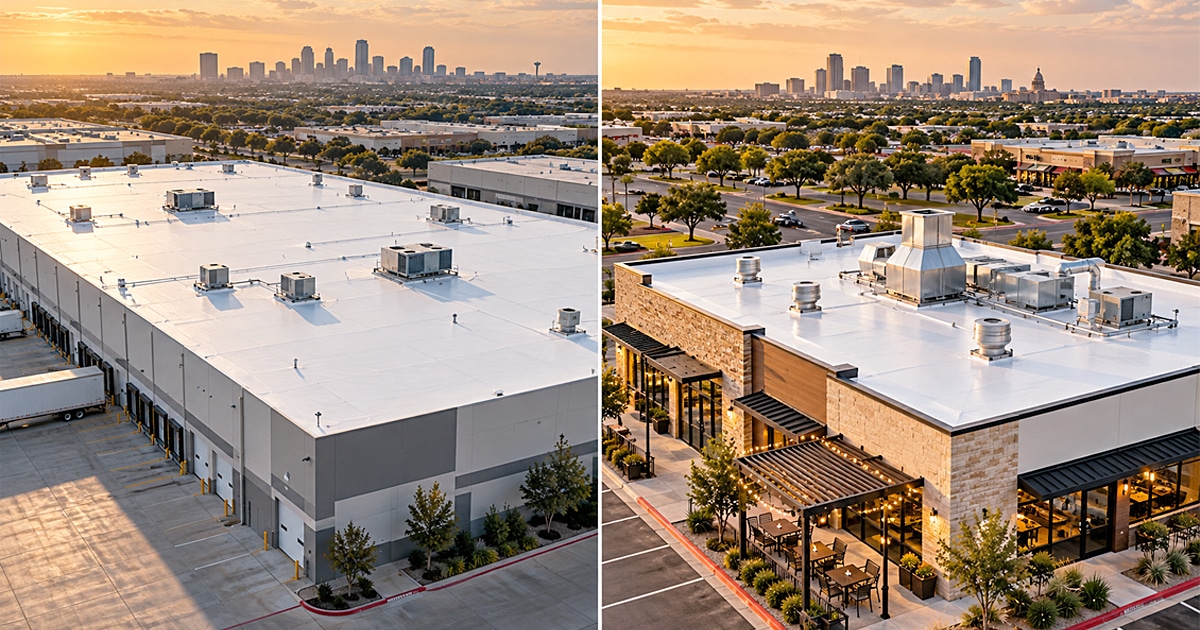
A San Antonio restaurant owner with grease-laden exhaust hoods faces a different roofing decision than an Austin warehouse manager covering 100,000 square feet of open storage. Both need a durable, reflective commercial roof that handles Texas heat, but the exposures on each rooftop are not the same. That difference shapes the TPO vs PVC roofing question more than any single spec sheet or price quote.
Neither material is universally better for commercial buildings in Texas. TPO roofing is often a strong fit for general-purpose low slope roofs where budget, solar reflectivity, and proper installation are priorities. PVC roofing tends to justify its higher cost where grease, oils, or chemical exposure makes membrane compatibility a real concern, such as restaurant and food-processing rooftops. In both cases, long term performance depends on the exact product selected, roof design, installation quality, drainage, and maintenance over the roof’s service life.
This guide walks building owners, property managers, and facility managers through every factor that separates TPO and PVC in Texas: costs, heat performance, chemical resistance, lifespan, severe weather durability, maintenance needs, and how to compare bids. Ja-Mar Roofing & Sheet Metal has worked on commercial roofing systems across Central Texas and brings a practical, field-tested perspective to this comparison.
Key Takeaways:
- TPO is often the more budget-friendly option. TPO roofing can be a practical choice for warehouses, retail centers, and other commercial buildings without significant grease or chemical exposure.
- PVC is worth considering for demanding rooftop exposures. Certain PVC roofing systems offer greater resistance to cooking grease, oils, and specific chemicals. Confirm compatibility and warranty limitations for the exact product.
- Both materials can support energy efficiency. Reflective white TPO and PVC membranes can reduce roof-surface heat absorption, but actual energy savings depend on insulation, roof design, building operations, and climate.
- Installation and assembly details matter as much as membrane choice. Heat-welded seams, cover boards, drainage, attachment methods, and flashing workmanship influence long-term performance in Texas weather.
- Compare the full installed roofing system. Review membrane thickness, insulation, attachment, roof deck conditions, warranties, and maintenance needs before choosing between TPO and PVC.
- There is no universal winner. The right commercial roofing system depends on building use, rooftop exposure, project budget, and the manufacturer’s requirements.
What Are TPO and PVC Commercial Roofing Systems?
TPO and PVC are both thermoplastic single-ply membranes used on commercial flat roofs across Texas. They share a basic concept: a factory-manufactured sheet of roofing material, installed in large rolls over insulation and a roof deck, with seams fused together using heat. Beyond that shared DNA, the two materials differ in resin chemistry, additive packages, chemical resistance, cost, and track record. This section covers each one in plain language.
Overview of Thermoplastic Single-Ply Roofing
On commercial property, the term single ply roofing membrane describes the waterproofing sheet, not every layer of the roof assembly. The full roofing system may include an air or vapor-control layer, polyisocyanurate insulation, a tapered drainage package, a cover board, attachment components, and perimeter flashings. These low slope roofing systems require a coordinated design because a sound membrane cannot compensate for saturated insulation or poor drainage. Both tpo and pvc roofing can be used in flat roofing systems, but the specification should describe each layer and its purpose.
A single ply membrane is exactly what it sounds like: a single layer of waterproofing material covering the roof. There are no built-up layers of tar and gravel. The membrane arrives in rolls, gets positioned over insulation and (often) a cover board, and the overlapping edges are heat welded to form a continuous, watertight bond.
“Thermoplastic” means the material softens under heat and resolidifies when it cools. That property is what allows hot-air welding equipment to fuse two sheets together at the seam, creating heat welded seams that can be as strong as the membrane itself when done correctly. This contrasts with thermoset membranes like EPDM roofing (a synthetic rubber membrane), which use adhesives or tape rather than heat welding for seam closure.
Typical membrane thicknesses for both TPO and PVC range from 45 mil to 80 mil (one mil equals one-thousandth of an inch). Thicker membranes cost more but offer better puncture resistance and tend to hold up longer under foot traffic, hail, and UV exposure. A 60-mil membrane is a common specification for many commercial buildings, but the appropriate thickness depends on the manufacturer, tested assembly, traffic, exposure, and warranty—not a universal Texas minimum.
What Is TPO Roofing?
TPO stands for thermoplastic polyolefin. The membrane is a blend of polypropylene and ethylene propylene rubber (EPR), combined with fillers, UV stabilizers, and sometimes block copolymers. A polyester reinforcement scrim is embedded in the membrane to add tear and puncture resistance.
Color options for TPO include white, light gray, and tan. White dominates Texas installations because it reflects solar energy and reduces heat buildup on the roof surface. TPO is popular for its affordability and energy efficiency, making it a common choice on warehouses around San Antonio, retail centers in Austin, logistics buildings along the I-35 and I-10 corridors, schools with large footprints, churches, and light industrial buildings.
Earlier TPO roofing products did not all weather or weld alike, and field experience pushed manufacturers to refine formulations, testing, and quality control. Current TPO roofing specifications should be judged by the exact product and its published performance data rather than by a complaint about an older membrane installed years ago. That matters when a property manager is comparing TPO and PVC for a new commercial roofing system.
What Is PVC Roofing?
PVC stands for polyvinyl chloride. A PVC roofing membrane is constructed of two layers of PVC with a polyester reinforcement sandwiched in between. The resin is blended with plasticizers (which keep the membrane flexible across a range of temperatures), UV stabilizers, fire-retardant additives, and sometimes performance enhancers like KEE (ketone ethylene ester) for improved long-term durability.
PVC roofing systems are often specified for restaurants, commercial kitchens, certain food-processing facilities, and industrial buildings where documented rooftop grease or chemical exposure requires careful material selection. Coastal location alone is not a reason to select PVC over TPO; the specified attachment and corrosion-resistant components often matter more. PVC has been installed on North American commercial roofs since the 1970s; TPO entered the market roughly two decades later. That longer track record gives PVC more field data on aging, plasticizer behavior, and long-term weathering.
Plasticizers are what keep PVC flexible, but in lower-quality formulations, plasticizers can migrate out of the membrane over time, leading to embrittlement and cracking. Manufacturers address that concern through product formulation and testing. Specifiers should evaluate the particular PVC membrane, not assume all PVC roofing systems age the same way.
Membrane Thickness, Reinforcement, and Attachment Methods
Both TPO and PVC membranes are available in 45-mil, 60-mil, and 80-mil options. Thickness can influence puncture resistance and installation costs, but a thicker sheet does not automatically outlast a thinner one. Reinforcement, thickness above the scrim, cover board, attachment, formulation, and rooftop use all matter.
Reinforcement over the scrim matters for tear strength and puncture resistance. ASTM D4434 addresses reinforced PVC membranes, while ASTM D6878 addresses TPO roofing membranes. Their material requirements are not identical, so an owner should compare the actual product data sheets and tested physical properties rather than assuming that a published overall thickness reveals the thickness above the reinforcement. Puncture and tear performance matter on commercial roofs visited by HVAC technicians and maintenance crews.
Three main installation methods are used on Texas commercial roofs:
- Mechanically attached: Fasteners and metal plates secure the membrane through insulation into the roof deck. Fasteners and plates hold the assembly to an approved roof deck. Material and labor costs may be favorable, but wind-uplift performance depends on the tested assembly, fastener density, building zone, and correct installation.
- Fully adhered: The membrane is glued to the insulation or cover board with adhesive or low-rise foam. Adhesive bonds the membrane to an approved substrate; depending on the specified system, this can reduce membrane flutter. It is not automatically more wind-resistant than a mechanically attached assembly: compare tested uplift ratings and the actual installation methods.
- Induction-welded: Electromagnetic induction bonds the membrane at specific attachment points, often used in high-wind perimeter and corner zones. This method is compatible with both TPO and PVC.
The attachment method affects wind performance, installed cost, and noise more than whether the membrane is TPO or PVC.
Heat-Welded Seams and Why They Matter
For building owners comparing TPO and PVC roofing, asking how seams will be tested is more useful than asking which resin makes the strongest weld. A commercial roofing system might include hundreds of feet of field seams and dozens of details around HVAC systems. Qualified crews perform test welds, adjust equipment to conditions, and probe or otherwise check finished work according to manufacturer guidance. A properly documented process helps protect the roof from leaks at vulnerable transitions.
Both TPO and PVC membranes are heat welded at seams using hot-air welding equipment. A roofing crew runs a calibrated machine along the overlap between two sheets, softening both surfaces so they fuse into a single bond. When installed correctly, the overlapping sheets form heat welded seams intended to create a watertight bond. Both TPO roofing and PVC roofing can achieve strong seams, but seam strength depends on product chemistry, surface preparation, weld settings, weather, and field quality checks. Claims that a seam is stronger than the sheet should be tied to a particular product test, not treated as universal.
Three types of connections require welding: field seams (where two sheets meet across the open roof), end laps (where one roll ends and the next begins), and flashings at penetrations, curbs, and edges. Flashings around HVAC systems, vents, and equipment curbs are the most common leak points on both TPO and PVC roofs, because these irregular shapes demand careful hand-welding by skilled installers.
Proper seam welding requires clean membrane surfaces, correctly calibrated welder temperature, appropriate travel speed, and favorable weather conditions. In Texas summers, ambient temperatures above 100°F can affect weld quality if installers do not adjust their technique. Poor installation at seams and flashing transitions is an avoidable source of leaks in either commercial roofing system, which makes proper seam welding and field checks especially important.
TPO vs. PVC Roofing: Side-by-Side Comparison
This section puts TPO and PVC next to each other across the factors that drive commercial roofing decisions in Texas. The table below is designed for quick scanning; the sections that follow go deeper on each factor.
| Factor | TPO | PVC |
|---|---|---|
| Base resin | Polypropylene / ethylene propylene rubber blend | Polyvinyl chloride with plasticizers and stabilizers |
| Reinforcement | Polyester scrim | Polyester scrim (sandwiched between two PVC layers) |
| Typical Texas applications | Warehouses, retail, logistics, schools, churches, light industrial | Restaurants, commercial kitchens, food processing, chemical-exposed, some coastal |
| Relative installed cost | Often lower upfront; compare like-for-like installed bids | Higher; premium for chemical/grease-resistant formulations |
| Heat and UV behavior | Good UV resistance in modern formulations; varies by manufacturer | Good UV resistance with long field track record; plasticizer quality matters |
| Solar reflectivity | Product-specific solar reflectance and SRI; check CRRC data | Product-specific solar reflectance and SRI; check CRRC data |
| Grease, oil, chemical resistance | Product-dependent; some greases and oils can accelerate degradation | Often preferred for specified grease/chemical exposures; verify compatibility |
| Puncture and impact resistance | Thickness-, reinforcement-, and assembly-dependent | Thickness-, reinforcement-, and assembly-dependent |
| Flexibility | No plasticizers; retains flexibility through resin chemistry | Plasticizers maintain flexibility, but can migrate in lower-quality products |
| Seam characteristics | Heat welded; strong when properly installed | Heat welded; verify product-specific seam test performance |
| Repair approach | Patching with compatible TPO; re-welding seams | Patching with compatible PVC; re-welding seams |
| Maintenance requirements | Inspect seams, flashings, drains; clean debris | Inspect seams, flashings, drains; clean debris |
| Warranty structures | Material-only or full-system NDL; up to 20–30 years | Material-only or full-system NDL; up to 25–30+ years |
| Expected service life | No guaranteed range; product, assembly, exposure, care matter | No guaranteed range; product, assembly, exposure, care matter |
TPO is often the right commercial roofing system for general-purpose low slope roofs where cost and reflectivity are the driving priorities, and where grease or chemical exposure is not a factor. PVC roofing can justify a premium for compatible grease- or chemical-exposed conditions. Neither material alone guarantees the longest roof life; actual service depends on the specified roofing system and its upkeep.
TPO vs. PVC Roofing Costs in Texas
Installed cost varies across Austin, San Antonio, Temple, Round Rock, and other Texas markets based on roof size, complexity, existing conditions, and material specifications. No single statewide average captures the range. What follows breaks cost into its components so owners can compare proposals intelligently.
Material Pricing Differences
TPO typically has a lower upfront installation cost than PVC at equivalent thickness and from the same manufacturer. The difference depends on membrane formulation, supplier pricing, attachment, insulation, project size, and the warranty tier, so a universal percentage premium is not reliable. Premium PVC membranes designed for restaurant or chemical-exposure applications carry an additional premium over standard PVC. TPO is often recommended for budget-conscious projects where chemical exposure is not a concern.
Roof Size, Layout, and Accessibility
A 200,000-square-foot warehouse near San Marcos with a flat, open deck and ground-level staging is far more cost-efficient per square foot than a 5,000-square-foot medical office with cut-up sections, multiple penetrations, and rooftop access only by ladder. Larger roofs spread mobilization, setup, and edge-detail costs over more area, reducing the per-square-foot price for both TPO and PVC.
Roof height, crane requirements, freight elevator access, and safety protocols (guardrails, tie-off points) add labor cost that applies equally regardless of membrane type.
Membrane Thickness, Insulation, and Cover Boards
Before pricing TPO roofing against PVC roofing, ask what sits beneath the single ply membrane. A low bid may omit a cover board or use a different insulation thickness, affecting energy efficiency, impact resistance, and total cost. Commercial property owners should request the same thermal performance and deck-repair assumptions on both proposals. Without those common specifications, the comparison says more about different roofing systems than the price of TPO versus PVC.
Moving from a 45-mil membrane to a 60-mil or 80-mil product usually raises material cost. It may improve some tested physical properties, but additional service life cannot be promised from thickness alone. For an accurate cost comparison, request local quotes for the same roof area, insulation R-value, cover board, attachment, edge details, demolition allowance, and warranty. Those installation costs can be a larger variable than the membrane price.
Insulation often represents a larger share of total cost than the membrane itself. Polyiso insulation layers, tapered insulation for drainage, and high-density cover boards (gypsum, HD polyiso, or fiberboard) all add to the installed price but directly affect energy efficiency, hail resistance, and how the membrane performs over time.
Tear-Off vs. Recover and Attachment Systems
When Texas codes and manufacturer specifications allow, installing a new membrane over an existing sound roof system (a recover) avoids tear-off labor and disposal costs. But moisture-damaged insulation, deteriorated decking, or code limits on the number of roof layers often require full tear-off, which changes the project cost significantly. Ask the contractor to itemize disposal, wet insulation, deck repairs, and any required code upgrades.
Installation costs also vary by attachment method. Mechanically attached and fully adhered single ply systems have different labor and material costs. Either can be engineered for demanding wind conditions using a qualified tested assembly; fully adhered systems may reduce some membrane flutter, but the wind rating must be verified. The choice depends on wind-zone requirements, deck type, and building use more than on whether the membrane is TPO or PVC.
Long-Term Ownership Costs
A cost comparison focused only on day-one price misses the reality of owning a commercial roof for 15 to 25+ years. Maintenance, storm repairs, energy performance, and potential business disruption from leaks all factor into total cost of ownership.
Hypothetical example (assumptions stated): A 10,000-square-foot restaurant roof receives two otherwise comparable proposals: a hypothetical PVC roofing system at $95,000 and a hypothetical TPO roofing system at $70,000. The difference is $25,000 upfront, but it does not establish which roof has the lower total cost. If the facility has persistent grease exposure, the owner must weigh documented chemical resistance, containment, inspections, potential repairs, and business disruption. Those future costs are uncertain, and the figures are illustration only—not local market quotes or a forecast of roof life.
White TPO roofing and white PVC roofing may support energy savings through reflective surfaces, but the amount depends on insulation, HVAC systems, climate, operating hours, and roof upkeep. A compatible PVC membrane may reduce exposure-related repair needs in demanding environments; that benefit must be weighed against its higher initial investment and actual maintenance needs. The right analysis depends on the building.
Which Material Handles Texas Heat and UV Exposure Better?
Central and South-Central Texas; Austin, San Antonio, Temple, Dripping Springs, the Highland Lakes area; regularly sees summer ambient temperatures above 100°F. Rooftop surfaces in direct sun can reach 150°F to 170°F, accelerating UV degradation, membrane expansion and contraction, and stress at seams and flashings. Both TPO and PVC roofing perform well under intense southern heat, but the details matter.
Reflectivity, Emissivity, and Roof Temperature
Commercial roof energy efficiency depends on more than a reflective white surface. On an Austin retail center, insulation R-value, rooftop equipment, interior operating hours, and conditioned floor area determine how much lower heat absorption might affect cooling costs. A reflective single ply roofing membrane can reduce heat buildup at the roof surface, but an uninsulated section of roof deck may still allow substantial heat transfer. Energy savings should be modeled for the actual building rather than promised from the membrane’s color.
White TPO roofing and white PVC roofing can provide highly reflective surfaces. Solar reflectance is typically reported on a 0-to-1 scale, while the Solar Reflectance Index (SRI) uses a different numerical scale; the values should not be confused. Compare product-specific initial and aged ratings in the Cool Roof Rating Council directory and check the locally adopted energy code before claiming compliance. The former ENERGY STAR Roof Products program ended in 2022, so neither material should be advertised using a current ENERGY STAR roof-product certification. A TPO roof has a reflective surface that reduces cooling costs by bouncing solar energy away from the building, and PVC performs comparably.
Reflectivity degrades over time as dirt, biological growth, and weathering accumulate on the membrane. Regular cleaning helps maintain reflective performance for both materials. Reduced cooling costs are possible but not guaranteed; energy performance of roofing systems depends on insulation thickness, HVAC systems, building envelope, occupancy patterns, and roof design more than membrane choice alone.
UV Resistance and Thermal Movement
Prolonged UV exposure and daily temperature swings (sometimes 60°F+ between afternoon peak and nighttime low) cause repeated expansion and contraction of both TPO and PVC membranes. Over years, this thermal cycling fatigues corners, seams, and flashings if they were not detailed properly during installation.
Modern TPO formulations are engineered with UV stabilizers specifically for high heat environments like Texas. PVC also performs well in Texas heat but ages differently depending on its plasticizer package. Lower-quality PVC can lose plasticizer content over time, leading to stiffening and surface cracking. Premium PVC formulations with enhanced stabilizers resist this degradation.
PVC roofing systems can offer useful chemical resistance for particular substances, but that does not establish that every PVC membrane resists UV rays better than every TPO membrane. Both families include products engineered for extreme heat and sunlight; compare manufacturer weathering tests, warranty conditions, and evidence from the exact roofing material. Product selection within each membrane family matters more than the family itself.
Role of Insulation, Color, and Installation Quality
Adequate polyiso insulation thickness and a high-density cover board reduce the thermal load that reaches the membrane, lowering surface stress for both TPO and PVC. White or light-colored membranes run measurably cooler than darker colors, regardless of resin type. A tan TPO membrane in Austin will absorb more heat than a white PVC, and vice versa; color selection is a bigger variable than plastic chemistry for roof surface temperature.
Poor installation (wrinkles, voids, bridging over fasteners, exposed membrane at unsupported spans) creates stress concentrations that accelerate failure in extreme heat. Installation quality affects both TPO and PVC equally; neither material compensates for a bad installation.
TPO vs. PVC for Restaurants and Commercial Kitchens
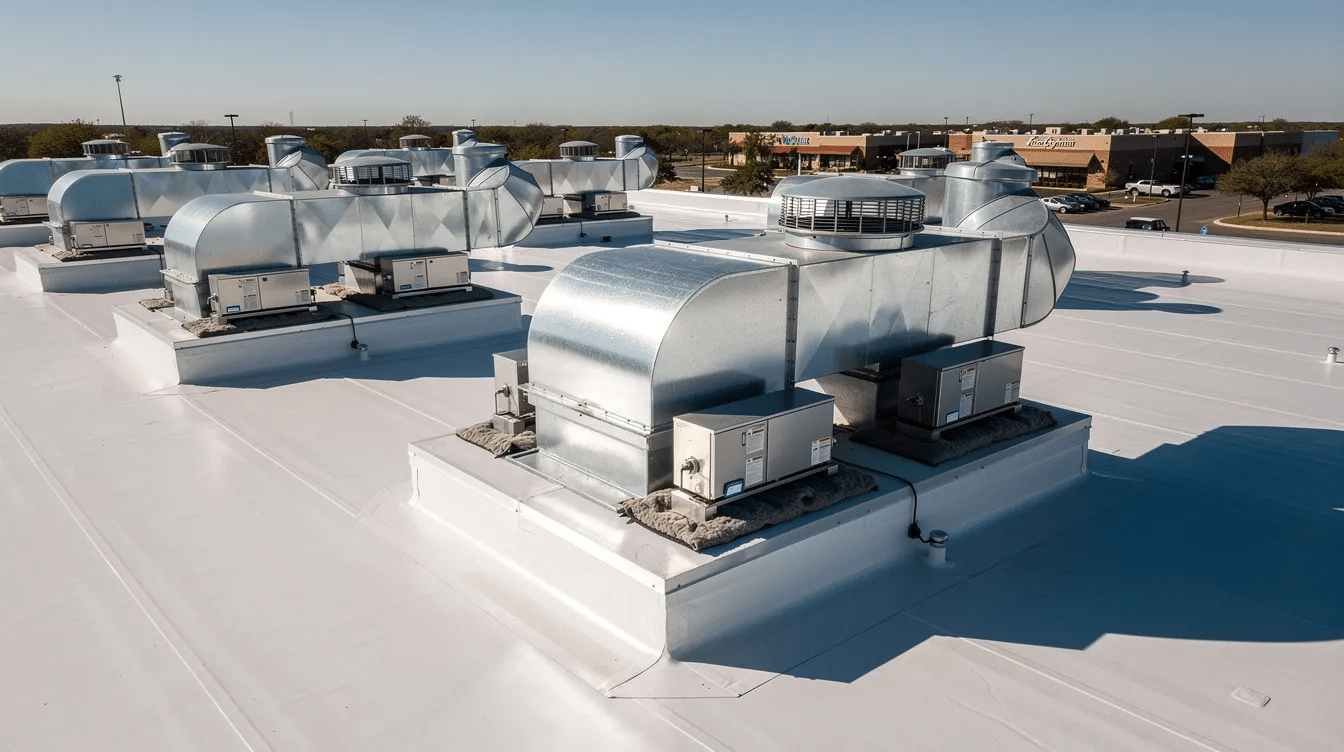
Rooftop grease exhaust is a specific, measurable threat to certain roofing materials. Barbecue restaurants in San Antonio, fast-food chains along I-35, and hotel kitchens in Austin all discharge some amount of grease-laden air through rooftop exhaust hoods. This section explains when that exposure drives the TPO-vs.-PVC decision.
Grease, Oils, and Chemical Exposure
A property manager should inventory what leaves the building through rooftop exhaust before choosing the roofing material. Fryer grease, food-processing residues, compressor oils, and industrial cleaning compounds are not interchangeable chemicals. If the industrial facility or commercial kitchen has routine chemical exposure, ask the manufacturer to evaluate the exact substances, concentration, frequency, and contact duration. The best roofing system for a warehouse can be the wrong system for a roof directly below a cooking exhaust fan.
Animal fats, vegetable oils, and aerosolized cooking grease can degrade many roofing materials over time. PVC roofing is often a stronger candidate than standard TPO roofing where rooftop grease or chemical exposure is documented, but no membrane is immune to every substance. Even some PVC membranes can lose plasticizers or deteriorate after repeated contact with certain fats and oils. PVC-KEE or another specifically approved roofing system may be more appropriate in demanding environments. Restaurants and food-processing facilities should ask for a written compatibility recommendation based on the actual substances and exposure frequency.
TPO’s chemical resistance to greases and oils ranges from limited to fair, depending on the specific product. Some manufacturer warranties exclude damage caused by grease or chemical exposure—including some PVC warranties. Check the actual coverage before choosing a commercial roofing system. That exclusion can leave a building owner responsible for costly membrane repairs or early replacement.
Not every PVC automatically resists every substance. Owners and specifiers need to match the PVC product’s published data sheets to the specific chemicals and greases present on the rooftop.
Exhaust Systems, Grease Containment, and Cleaning
A well-designed grease containment system around rooftop exhaust hoods reduces the amount of grease that contacts the membrane. Containment pans, curbs, and regular filter maintenance limit the chemical exposure load regardless of membrane type.
Cleaning schedules matter. Both TPO and PVC manufacturers publish lists of approved cleaning agents. Using unapproved solvents on PVC can strip plasticizers, and harsh chemicals on TPO can degrade the surface. Following manufacturer cleaning instructions protects the warranty and the membrane.
When TPO Can Work and When PVC Is Worth the Premium
Low-grease food operations (a sandwich shop with minimal frying, a bakery with electric ovens) or buildings adjacent to restaurants but without direct grease discharge may function well with a robust 60-mil or 80-mil TPO membrane, provided grease containment is effective.
PVC is preferred for buildings exposed to heavy fryer exhaust, large grease-laden hood systems, and certain industrial chemicals. Ja-Mar typically recommends getting job-specific guidance from the membrane manufacturer before committing to TPO in any food-service environment.
Durability, Puncture Resistance, and Severe Texas Weather
Storms, hail, and rooftop foot traffic drive more real-world roof damage in Texas than slow UV aging. Durability is about the entire assembly: membrane, insulation, cover board, attachment, and detail work, not just the membrane type alone.
Hail, Wind Uplift, and Storm Exposure
Central Texas and the Hill Country experience regular hail events, high winds from thunderstorm outflow, and heavy downpours. Both TPO and PVC systems can achieve tested wind-uplift ratings when installed per approved assemblies (FM-approved or UL-listed configurations with specified fastener patterns, insulation, and edge details).
Hail resistance depends on assembly design more than membrane family. A 60-mil membrane over a high-density gypsum cover board absorbs hail impact better than an 80-mil membrane over bare polyiso, because the cover board distributes force. Membrane thickness contributes, but the cover board and underlying assembly do the heavy lifting in hail performance.
Foot Traffic, Rooftop Equipment, and Puncture Resistance
Where heavy foot traffic is unavoidable, specify a marked route to HVAC systems with compatible walkway pads and protection around frequent service points. A single ply membrane should not become the work platform for dropped tools or unsecured equipment. For demanding environments, a cover board or reinforced assembly may provide more practical durability than simply upgrading from one membrane family to the other. Both PVC roofing systems and TPO roofing systems benefit from these precautions.
HVAC technicians, satellite installers, and maintenance crews create wear paths and puncture risks on every commercial roof. Neither TPO roofing nor PVC roofing is automatically more puncture-resistant at the same nominal thickness. Scrim design, membrane formulation, material above the reinforcement, cover-board support, and service traffic determine performance. TPO can offer excellent puncture resistance, and flexible PVC membranes can also perform well; product testing and walkway protection offer a more reliable basis for comparing tpo and pvc roofing.
Walkway pads, protective pavers along service routes, and equipment support curbs increase resilience for both membrane types. These accessories add modest cost during installation and prevent expensive puncture repairs later.
Ponding Water and Drainage
Standing water on a flat roof accelerates membrane aging, traps dirt, promotes biological growth, and can cause seams to deteriorate over time. Neither TPO nor PVC is immune to ponding-water damage, although both can handle intermittent standing water when installed per manufacturer instructions.
Tapered insulation to promote drainage, properly sized and positioned drains and scuppers, and regular drain-clearing maintenance are more effective at preventing ponding damage than membrane selection. A well-drained TPO roof may perform better over time than a poorly drained PVC roof, although roof life always depends on more than drainage alone.
Expected Lifespan: Does PVC Last Longer Than TPO?
Building owners often want a simple number. The reality: no membrane type alone guarantees a specific lifespan.
Factors That Control Service Life
Common planning discussions cite roughly 10–25 years for TPO roofing and 15–30 years for PVC roofing, but these broad ranges are not reliable predictions for any particular building. Actual service life may fall outside them, and some well-designed TPO systems can outperform poorly designed PVC systems. These ranges overlap because membrane thickness, reinforcement quality, product formulation, installation quality, drainage, chemical exposure, rooftop traffic, and maintenance all influence how long a roof actually performs.
A single severe hailstorm or years of deferred maintenance can shorten service life far more than the inherent aging rate of either material. Where verified grease or chemical compatibility favors PVC, the right PVC roofing system may avoid certain exposure-related failures that would shorten an unsuitable TPO roof. That does not establish a universal lifespan advantage.
Warranties vs. Real-World Lifespan
When reviewing manufacturer warranties, request the specimen warranty for the exact proposed roofing system, not a marketing summary showing only the term. Compare who is responsible for inspection, how leaks are reported, whether edge metal and flashings are included, which exclusions apply to chemicals and accidental punctures, and whether a commercial property owner must document maintenance. The contract and the roof’s actual performance are different things.
Manufacturer warranties range from 10 to 30 years for both TPO and PVC systems. A warranty defines what the manufacturer will cover under specific conditions; it does not predict how long the roof will actually function. Common warranty exclusions include certain hail sizes, puncture damage from foot traffic or dropped tools, ponding water beyond specified durations, unauthorized repairs, and failure to maintain inspection schedules.
A 20-year PVC warranty next to a 20-year TPO warranty does not mean the two roofs will perform identically. The warranty terms, exclusions, and whether it is a material-only or full-system No Dollar Limit (NDL) warranty all affect the owner’s actual protection.
How Texas Conditions Influence Aging
UV intensity, extreme heat, occasional freezes, and storm frequency in the Austin-to-San Antonio corridor age both membranes. Proper installation is crucial for both TPO and PVC roofs. Professional installation is crucial for maximizing roof lifespan, and installation quality directly shapes how well either membrane handles the decades of thermal cycling and weather stress that Texas delivers.
Well-installed and maintained TPO and PVC roofs can both serve reliably for decades in Texas when matched to the building’s use and exposure profile.
Repairs, Maintenance, and Long-Term Ownership
Even the best roofing system needs routine inspections and occasional repairs. Good maintenance practices are nearly identical for both TPO and PVC roofs.
Routine Inspections and Preventive Care
Maintenance needs also vary with rooftop activity. An office building whose HVAC systems receive monthly service has different foot-traffic exposure from a storage warehouse with few roof visits. Routine inspections should document drains, equipment supports, seams, rooftop traffic routes, and prior repairs with dated photographs. If a professional inspection uncovers wet insulation or a recurring detail failure, the maintenance plan should address the source rather than add another temporary patch.
Commercial roofs in Texas should be inspected at least twice per year (spring and fall) plus after any severe storm event. A professional inspection should cover seams, flashings, drains, scuppers, pitch pans, rooftop HVAC units, walk paths, and any previous repair areas.
Minor issues; loose edge metal, a small puncture from a dropped wrench, a partially lifted flashing; become active leaks if ignored through a rainy season. Catching problems early is the cheapest form of roof maintenance.
Common Repairs on TPO and PVC Roofs
Typical repairs include patching punctures with compatible membrane material, re-welding separated seams, replacing deteriorated flashings, and resecuring termination bars. For both TPO and PVC, repairs require manufacturer-approved materials and correct weld settings. Using the wrong patch material or incompatible adhesive can void the warranty and fail within months.
In-house facilities teams can safely handle debris removal, drain clearing, and visual inspections. Welding repairs, flashing replacement, and membrane patching should be performed by experienced commercial roofing contractors with the right equipment and training.
Financial Impact of Deferred Maintenance
Deferred maintenance leads to wet insulation (which loses R-value and adds weight to the structure), interior ceiling and wall damage, disrupted operations in offices or retail spaces, and potential mold remediation costs. Repeated emergency leak calls can become more expensive than planned upkeep, especially when interior damage and operational downtime are included. Preventive work reduces some risks but cannot prevent every leak or storm-related loss.
Which Roof Works Best for Different Texas Commercial Buildings?
There is no single best roofing system for all buildings. The right choice depends on the building’s use, rooftop exposures, owner’s budget, and how long the owner plans to hold the property.
Warehouses and Distribution Centers
Large, open roofs with limited rooftop grease, substantial sun exposure, and cost sensitivity. TPO is often used for warehouses, retail centers, and distribution facilities because it delivers good reflectivity at a lower installed cost. PVC is sometimes specified when an owner or tenant has specific chemical exposures or simply prefers the longer track record.
Retail Centers and Shopping Plazas
Mixed-use rooftops with retail tenants, some restaurants, and multiple HVAC units present a split-exposure challenge. Some facilities combine TPO on “clean” roof areas with PVC or specialized membranes near high-grease restaurant exhausts, when the manufacturer and design allow that approach. This requires careful detailing at the transition.
Office Buildings and Medical Offices
Low to moderate rooftop traffic, minimal chemical exposure, and a priority on quiet, leak-free interiors. Either TPO or PVC works; the decision often comes down to budget, architect specification, and owner preference. Energy efficient white membranes in either material reduce utility costs in Texas summers.
Restaurants, Commercial Kitchens, and Food-Service Facilities
PVC is frequently the better choice for restaurant roofs in Austin, San Antonio, and tourist corridors where heavy grease exhaust is a constant. Even with PVC, rooftop layout, hood types, and grease containment design still need careful planning. A PVC membrane does not eliminate the need for proper exhaust management.
Multifamily, Schools, and Institutional Buildings
Dormitories, multifamily flat sections, K-12 schools, and public buildings across Central Texas often operate on tight budget cycles with long ownership horizons. TPO is frequently chosen for cost and reflectivity. PVC is sometimes specified by architects for institutional projects that prioritize fire resistance or where the specification calls for a membrane with a longer field track record. Noise during replacement and energy efficiency are common considerations for occupied buildings.
Manufacturing, Industrial, and Specialized Facilities
Some industrial buildings combine chemical exhaust, frequent mechanical service, and sensitive production areas. In those settings, the right commercial roofing system may involve a specified PVC or PVC-KEE membrane, dedicated containment around discharge points, protected access routes, and special flashing details. An industrial facility should provide a chemical inventory and operations schedule before contractors finalize a specification; an attractive per-square-foot quote alone cannot establish long term performance.
Process chemicals, exhaust, industrial oils, and solvents on an industrial facility’s rooftop call for membrane compatibility analysis. PVC or specialized PVC formulations are often considered when manufacturer data supports resistance to the specific exposures. In industrial buildings where chemical exposure is documented, PVC systems are worth the cost premium.
Coastal Commercial Buildings
Coastal facilities near Corpus Christi and the Gulf face higher wind speeds, salt-laden air, persistent moisture, and corrosion concerns. Both TPO and PVC can perform well, but attachment method, corrosion-resistant fasteners, and robust edge-metal design may be higher priorities than membrane choice alone. The roofing system assembly, not just the membrane, determines coastal performance.
Central Texas vs. Coastal Texas Roofing Considerations
Geography influences design priorities for flat roofing systems, but it does not automatically dictate TPO or PVC.
Central Texas: Austin, Round Rock, Buda, San Antonio, Temple, Dripping Springs, Highland Lakes
High heat, strong UV, occasional hail events, and Hill Country wind exposure are the primary design drivers. Reflectivity matters for energy costs. Hail-resistant assemblies (thicker membrane, high-density cover boards, properly spaced fasteners) are standard practice for most commercial buildings. Both TPO and PVC are widely used in these markets; the deciding factor is usually building use and chemical exposure rather than climate alone.
Coastal Texas: Corpus Christi and Gulf-Area Markets
Higher sustained wind speeds, hurricane potential, salt-laden air, and persistent humidity shift priorities toward attachment design, corrosion-resistant fastener plates, and robust edge details for either TPO or PVC. Fastener corrosion from salt air can undermine a mechanically attached roof within a decade if standard carbon-steel fasteners are used instead of stainless or coated alternatives. Drainage and moisture management are also elevated concerns on coastal roofs where driving rain and high humidity keep surfaces wet longer.
Manufacturer Specifications, Codes, and Warranty Requirements
Many key decisions about TPO and PVC are driven by manufacturer specifications and building codes, not just personal preference.
Relevant Standards: ASTM D6878 (TPO) and ASTM D4434 (PVC)
ASTM D6878 covers TPO membranes and defines minimum criteria for thickness tolerances, tear strength, elongation, and resistance to heat aging. ASTM D4434 covers PVC membranes with similar physical-property requirements, plus specifications for plasticizer migration and heat aging. Compliance with these standards establishes a baseline; it does not make all products within a category identical. Two 60-mil TPO membranes from different manufacturers can have meaningfully different UV stability, scrim quality, and seam weldability.
Codes, Approvals, and Tested Assemblies
Fire resistance belongs to the tested roof assembly rather than a blanket claim about all membranes. A TPO roofing system and a PVC roofing system can each be part of a rated assembly when the complete combination of deck, insulation, cover board, and membrane meets the required listing. Owners of industrial buildings and retail facilities should ask for the actual assembly identification, the governing jurisdiction’s requirements, and written confirmation that substitutions do not invalidate the approval.
Texas commercial projects typically reference the International Building Code (IBC) with local amendments, plus energy codes (IECC or ASHRAE 90.1). Tested assemblies (FM-approved, UL-listed) define specific combinations of membrane, insulation, cover board, fastener pattern, and deck type that have been tested for wind-uplift and fire-performance ratings. The assembly design; fastener density, insulation type, deck type; is as important as the membrane brand.
For coastal and hurricane-prone zones, wind-uplift requirements per ASCE 7 and relevant local addenda dictate attachment patterns and edge-securement details. Meeting those requirements costs more but is non-negotiable for code compliance and insurer acceptance.
Warranty Requirements and Limitations
Common warranty types include material-only (covers membrane manufacturing defects), labor-and-material (covers the installed system including flashings and workmanship), and full-system No Dollar Limit (NDL) warranties (the manufacturer does not cap payout per square foot). NDL warranties are important for larger commercial roofs where a capped warranty might not cover the actual cost of repair or replacement.
Typical warranty requirements include use of an approved contractor, specific detail designs, a completion inspection, and ongoing maintenance obligations. Manufacturer warranties often exclude damage from hail above a certain diameter, punctures from mechanical abuse, ponding water beyond a specified duration, and unauthorized repairs.
How to Compare TPO and PVC Roofing Proposals
Two “TPO bids” or two “PVC bids” may describe completely different roofing systems. Owners must compare details, not just the bottom-line price.
Bid Comparison Checklist
An apples-to-apples proposal needs more than a line for membrane thickness. For commercial flat roofs, request a roof plan identifying drains, penetrations, edge lengths, access points, and any areas requiring tapered insulation. Ask experienced commercial roofing contractors which installation methods they propose and why that specific design satisfies wind uplift, energy efficiency, and service conditions. The better bid explains scope and risk as clearly as total cost.
When comparing TPO and PVC roofing proposals, line up these items side by side:
- Exact membrane manufacturer, product line, and thickness
- Insulation type, total R-value, number of layers, and whether tapered insulation is included for drainage
- Cover-board type and thickness (gypsum, HD polyiso, fiberboard, or none)
- Attachment method: fastener patterns, adhesive type, induction welding, perimeter and corner enhancements
- Flashing details at walls, parapets, curbs, penetrations, and roof-edge terminations
- Scope of drain, scupper, and overflow protection work; plans for correcting existing ponding
- Tear-off scope, deck inspection and repair provisions, and handling of wet insulation
- Manufacturer warranty type, term, and any NDL or enhanced coverage upgrades
- Contractor workmanship warranty length and scope
- Any included maintenance or inspection program after installation
- Total installed scope, including permits, dumpsters, and protection of the building during work
Why the Lowest Price Is Not Always the Best Value
A lower bid may reflect thinner membrane, less insulation, reduced fastener density, weaker flashing details, a shorter warranty, or missing scope items like drain repair and tapered insulation. Asking specific questions about each line item before assuming two bids are comparable protects the owner from paying less for a system that costs more to maintain or replace sooner. The right roofing contractor will walk an owner through these differences rather than just presenting a low number.
When to Repair a Commercial Roof Instead of Replacing It
Not every aging commercial roof needs full replacement. Targeted repairs can extend service life in many Texas commercial buildings and delay the capital expense of a roof replacement.
Situations Where Repairs Make Sense
Localized membrane damage from a dropped tool or isolated hail bruises on an otherwise sound membrane can be patched with compatible material and re-welded. Seam separations in an otherwise intact membrane can be cleaned and re-welded if the surrounding membrane is still flexible and well-adhered. Early-stage leaks where insulation is still mostly dry and the roof deck is structurally sound are good candidates for repair rather than replacement.
When Replacement Is the Better Investment
Widespread wet insulation confirmed by infrared scanning or core samples across large roof areas indicates systemic failure that patching cannot fix. Multiple prior repairs with recurring leaks, membrane cracking across broad areas, or severe hail damage that has compromised the membrane’s waterproofing integrity all point toward replacement. Roofs already at or past their expected service life with limited or expired warranty coverage are usually better served by a new roofing system than by continued repair spending.
Importance of Professional Roof Evaluation
Not every professional inspection requires infrared scanning or core sampling. The roofing contractor should select diagnostic methods that fit the symptoms, weather, construction, and suspected moisture conditions. A small flashing leak may need close visual examination, while widespread insulation moisture may justify non-destructive testing and carefully located confirmation samples. Building owners should receive a clear explanation of findings before approving a roof replacement.
Guessing based on ceiling stains alone leads to either unnecessary replacement or inadequate patching. A professional inspection starts with a visual assessment and documented findings. Infrared moisture scanning, core sampling, or other testing may be recommended when the roof conditions warrant them before deciding between repair and replacement. This evaluation can help avoid unnecessary work and reduce the risk of leaving a larger moisture problem unresolved.
How Ja-Mar Roofing & Sheet Metal Helps Texas Commercial Property Owners
Ja-Mar Roofing & Sheet Metal serves as a practical resource for evaluating whether TPO or PVC is the right fit for a specific Texas commercial property.
Evaluation, Specification, and Project Planning
When discussing TPO and PVC options with Ja-Mar, commercial property owners can review current roof conditions, building use, and rooftop exposures (grease, chemicals, coastal salt air, hail-prone location). Ask the team which evaluation services and assembly options are available for the specific project, including membrane type, insulation, attachment method, and applicable warranty terms. Building owners considering commercial roof replacement or looking for the right commercial roofing system for a new build can request a site evaluation.
Installation, Repairs, and Maintenance Programs
Ja-Mar Roofing & Sheet Metal can help commercial property owners discuss roofing options, evaluate the existing roof, and plan an appropriate installation or repair scope. Before specifying a particular membrane or warranty, confirm the product, approved installation requirements, available services, and current project schedule with the team. For commercial property owners in Austin, San Antonio , Temple, and surrounding markets, clear documentation of roof conditions and proposed work makes comparing TPO and PVC much easier. Contact Ja-Mar for a site-specific TPO vs. PVC evaluation.
What Texas Building Owners Should Prioritize
Comparing TPO and PVC comes down to matching the roofing material to the building’s actual conditions, not to marketing claims or brand loyalty. There is no universal winner.
When selecting a commercial roof, prioritize:
- Define building use and rooftop exposures clearly. Grease, chemicals, industrial exhaust, and salt air narrow the membrane options. Most commercial buildings without those exposures can perform well with either TPO or PVC.
- Address drainage, insulation, and attachment design, not just membrane type. A well-designed assembly with proper slope, adequate insulation, a quality cover board, and the right attachment method for the wind zone will outperform a premium membrane installed over a poorly designed assembly.
- Insist on detailed, apples-to-apples proposals. Use the bid comparison checklist above to ensure you are comparing the same scope, thickness, warranty, and attachment methods.
- Commit to routine inspections and preventive maintenance. Both TPO and PVC reward consistent care with longer roof life and fewer emergency repairs.
- Choose the right roofing contractor. Proper installation determines whether a membrane reaches year 10 or year 25. Experienced commercial roofing contractors with documented training on the specific membrane system reduce risk.
For a site-specific TPO vs. PVC evaluation on your Texas commercial property, contact Ja-Mar Roofing & Sheet Metal . The team serves Austin, San Antonio, Temple, and surrounding Central Texas communities. Ask for a review of building use, existing roof conditions, possible chemical exposure, and competing commercial roofing system options before committing to a specification.
Technical References for Comparing TPO and PVC Roofing
- GAF commercial TPO and PVC roofing system comparison — chemical resistance, puncture protection, UV behavior, and warranty limitations.
- GAF guide to chemical resistance of single-ply membranes — how grease, oils, and other substances affect membrane selection.
- ASTM D6878 specification — material-performance baseline for TPO membranes.
- ENERGY STAR Roof Products program notice — confirms the roof-product specification was discontinued in 2022.
Frequently Asked Questions About TPO vs. PVC Roofing
Is TPO or PVC cheaper for commercial roofs in Texas?
TPO is usually less expensive upfront. TPO roofing often costs less upfront than a comparable PVC roofing system, but there is no trustworthy statewide installed-price range that applies to every commercial property. The cost difference depends on roof size, roof deck condition, membrane thickness, insulation, drainage, attachment, flashings, and warranty. Request two written bids for the same scope and installation methods before calculating the actual premium.
Which lasts longer in Texas heat: TPO or PVC?
Planning estimates sometimes place TPO roofs around 10–25 years and PVC roofs around 15–30 years, but neither interval is guaranteed and the ranges overlap. There is no guaranteed winner based on membrane type alone. Product formulation, membrane thickness, proper installation, drainage design, maintenance, and exposure conditions all influence how long either material performs in Texas conditions.
Is PVC always better for restaurants?
PVC is often preferred where grease exposure is present because PVC formulations resist animal fats, vegetable oils, and cooking exhaust better than TPO. But “PVC” is not a single product; resistance to specific substances depends on the exact formulation. Always confirm compatibility with the manufacturer’s published data for the specific greases and chemicals on the rooftop.
Will a white TPO or PVC roof definitely lower my energy bills?
Reflective white TPO roofing and PVC roofing may reduce rooftop heat absorption and contribute to lower cooling costs. White membranes with verified solar reflectance and thermal-emittance ratings can reduce heat absorption and contribute to energy savings; check product-specific CRRC listings rather than applying a single SRI value to both materials. But guaranteed cooling bill reductions depend on too many variables: insulation thickness, building envelope, HVAC systems efficiency, occupancy, and climate zone. A reflective membrane helps; it does not single-handedly control energy costs.
How does hail affect TPO vs. PVC roofing?
Both TPO and PVC can be damaged by severe hail. Hail resistance is primarily an assembly-level characteristic, not a membrane-type characteristic. Thicker membranes (60 to 80 mil), high-density cover boards, and proper fastener patterns all increase hail resilience. Neither membrane is hail-proof; both benefit from the same protective assembly design.
Are TPO and PVC roofs covered by insurance after storms in Texas?
Some commercial property policies cover specified storm damage to roofing systems, subject to the policy wording, deductibles, limitations, exclusions, and the insurer’s assessment of the damage. Insurers typically send an adjuster to evaluate whether damage warrants repair or replacement. Coverage varies by policy; owners should review their specific terms with their insurance provider. A commercial roofing contractor can document roof conditions and the proposed repair scope while the property owner confirms coverage questions with the insurer.
Can you install TPO over an existing PVC roof or vice versa?
Cross-membrane recovers (TPO over PVC or PVC over TPO) present compatibility issues. Chemical interactions between membrane types can degrade the new membrane or the existing one. Additionally, Texas building codes limit the total number of roof system layers, and manufacturer warranties typically require approved recover systems. A professional inspection of the existing roof is needed before deciding on a recover approach.
How often should a TPO or PVC roof be inspected?
At least twice per year (spring and fall), plus after any severe weather event such as hail, high winds, or heavy rain. Texas weather justifies more frequent inspections than moderate climates because storm damage can go unnoticed for months if no one walks the roof.
Which membrane is more puncture-resistant?
Membrane thickness, scrim reinforcement, and the presence of a cover board drive puncture resistance more than TPO vs. PVC alone. At equivalent thickness, the better-performing membrane cannot be identified by resin type alone; test reports, reinforcement, a protective cover board, and access walkways should guide the selection. However, an 80-mil TPO over a gypsum cover board will outperform a 45-mil PVC with no cover board. Assembly design matters.
What maintenance does a TPO or PVC roof need?
Recurring tasks include clearing drains and scuppers, checking seams and flashings, inspecting walk paths and equipment curb areas, removing debris, and scheduling a professional inspection at least twice annually. Keeping the membrane clean preserves reflectivity and makes it easier to spot damage early.
Can my facilities team handle minor repairs on TPO or PVC?
Facilities staff can safely handle debris removal, drain clearing, and visual inspections. Membrane welding, flashing repairs, and patching require specialized hot-air equipment, manufacturer-approved materials, and trained operators. Attempting seam repairs without proper training risks causing additional damage and voiding the manufacturer warranty.
Are TPO and PVC considered environmentally friendly?
Both materials may be recyclable through eligible manufacturer or third-party programs, but collection and processing are not available for every roof or region. Their reflective surfaces reduce heat buildup and can lower cooling energy consumption, contributing to a building’s overall energy efficiency. PVC and TPO have different manufacturing chemistries and environmental trade-offs. Project teams should look for product-specific environmental product declarations, installation waste practices, and local take-back options rather than treating either as automatically green. Neither material is perfectly “green,” but both contribute positively through reflectivity and recyclability.
How do manufacturer warranties for TPO vs. PVC typically differ?
Warranty structures (material-only, labor-and-material, NDL) are similar between TPO and PVC product lines. Differences tend to appear in exclusions (some TPO warranties exclude grease exposure), maximum warranty terms (some premium PVC systems offer 30-year NDL warranties), and the manufacturer’s maintenance requirements. Comparing warranty documents side by side is more useful than comparing membrane types in the abstract.
How long does it take to install a new TPO or PVC roof on a typical Texas commercial building?
Installation time for a 10,000- to 20,000-square-foot roof varies with demolition scope, building occupancy, weather, deck repairs, rooftop equipment, crew size, and required inspections. Ask for a phased schedule rather than assuming a fixed number of working days. Larger or more complex roofs (many penetrations, multiple levels, occupied buildings requiring phased work) take proportionally longer. Some crews find a particular PVC product more flexible around details, but installation speed depends on membrane handling, weather, crew experience, access, and roof complexity. There is no dependable rule that PVC installs faster than TPO.
Can TPO and PVC both meet fire-resistance requirements?
Yes, but fire resistance is established for a tested roof assembly, not by the membrane name alone. Both TPO roofing and PVC roofing systems may be included in assemblies that meet applicable fire classifications. Ask the right roofing contractor for the specific listed assembly and verify that the roof deck, insulation, membrane, and attachment match the approved design.
Is EPDM roofing another option for commercial flat roofs?
Yes. EPDM roofing uses a synthetic rubber membrane rather than a thermoplastic single ply roofing membrane. EPDM systems typically join seams with approved tapes or adhesives instead of hot-air welding. That makes EPDM roofing a separate comparison with its own installation methods, reflectivity options, and maintenance needs. Owners choosing between TPO and PVC should consider EPDM roofing if the building conditions or project specifications make that alternative relevant.

